 Peps
Peps
What is LL-37?
LL-37 is a human host-defense peptide investigated in wound biology. The selected clinical study tested topical treatment in a defined ulcer population.
Biological role or research focus
Host-defense peptide and wound research.
A topical wound trial cannot establish the safety or effect of a systemic research product.
Role reference: Evaluation of LL-37 in healing of hard-to-heal venous leg ulcers: A multicentric prospective randomized placebo-controlled clinical trial. ↗
Names you may encounter
LL37 · LL 37 · cathelicidin
Search terms can include brands, combinations, or historical names. They are not automatic product equivalents.
- Class / identity
- Host-defense peptide
- Main research area
- Wound-healing research
- Evidence featured
- Human phase 2b trial
- Source check
- October 4, 2026
Molecular structure
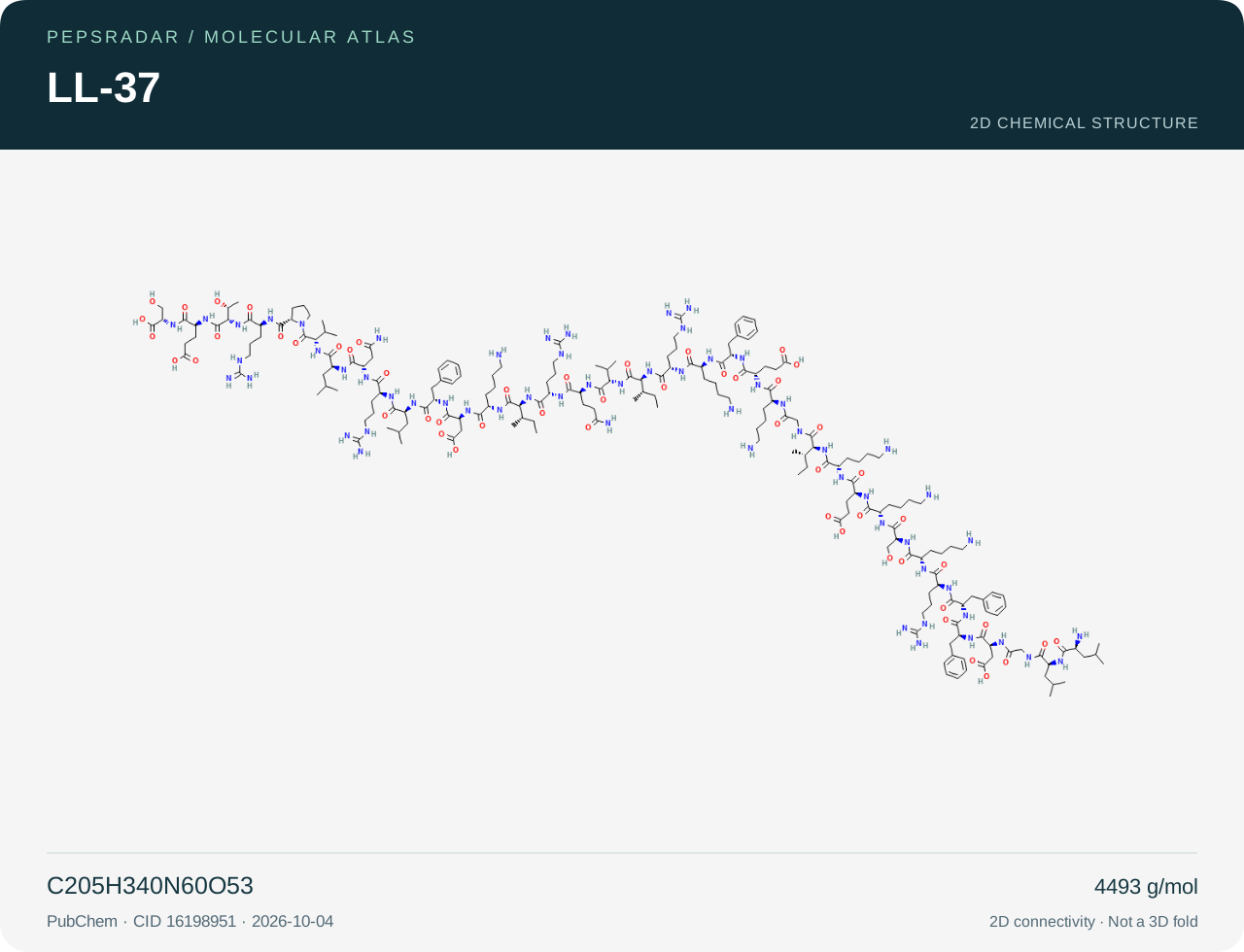
Mechanism & research rationale
Its biological context includes innate defense and tissue responses. Whether those properties improve healing must be tested against standard care in the relevant type of wound.
Research context & status
HEAL LL-37 evaluated topical treatment plus compression for venous ulcers. It did not establish systemic infection treatment or a general immune-enhancement use.
What does the evidence show?
Selected published evidence, with the population, findings, and limits kept together. These original summaries draw on publication abstracts; they are not a systematic review.
Human phase 2b trial · 2021
HEAL LL-37
Evaluation of LL-37 in healing of hard-to-heal venous leg ulcers: A multicentric prospective randomized placebo-controlled clinical trial.
- Population / model
- 148 people with hard-to-heal venous leg ulcers.
- Study design
- Topical LL-37 versus placebo, alongside compression therapy.
- Main finding
- The full study population showed no significant healing improvement. A post hoc subgroup with larger ulcers showed signals of benefit.
- Limits & context
- A subgroup found after the main analysis is hypothesis-generating. Topical tolerability cannot establish the safety of systemic injection or prove antimicrobial benefit for unrelated infections.
Human randomized trial · 2014
LL-37 · first topical ulcer trial
Did the early wound-healing signal persist in larger research?
- Population / model
- 34 people with hard-to-heal venous leg ulcers.
- Study design
- Placebo run-in, four-week double-blind treatment with three topical concentrations or placebo, and four-week follow-up.
- Main finding
- The lowest concentration had a significantly higher healing-rate constant than placebo (P=0.003); the middle comparison did not reach significance (P=0.088). The highest concentration showed no healing difference.
- How to read it
- Within-group wound reduction and a treatment-versus-placebo comparison answer different questions.
- Limits & context
- Small sample and short follow-up limit confidence. The later 148-person trial did not improve healing overall. These topical findings do not establish systemic antimicrobial efficacy or safe injectable use.
Read the original paper for methods, adverse events, funding, and conflicts of interest. Publisher access may require a subscription.
Related records in our PubMed snapshot
Combinatorial therapy of LL-37 and ADSCs accelerates diabetic wound repair by orchestrating NRROS-mediated crosstalk between TGF-β/SMAD and hippo/TEAD1 axes. ↗
Cytokine · Issue date 2026 Nov · Not appraised
WITHDRAWN: Corrigendum to "Oroxylin A suppress LL-37 generated rosacea-like skin inflammation through the modulation of SIRT3-SOD2-NF-κB signaling pathway" [Int. Immunopharmacol. 129 (2024) 111636]. ↗
International immunopharmacology · Issue date 2026 Oct 15 · Not appraised
Corrigendum to "Oroxylin A suppress LL-37 generated rosacea-like skin inflammation through the modulation of SIRT3-SOD2-NF-κB signaling pathway" [Int. Immunopharmacol. 129 (2024) 111636]. ↗
International immunopharmacology · Issue date 2026 Oct 1 · Not appraised
Exposure to the antimicrobial peptides LL-37 and ATRA-1 induces a lipidome response in Staphylococcus aureus that alters membrane biophysical properties. ↗
Biochimica et biophysica acta. Biomembranes · Issue date 2026 Oct · Not appraised
Coordination chemistry and antimicrobial activity of LL-37, its C-terminal fragment, and a peptidomimetic analogue. ↗
Dalton transactions (Cambridge, England : 2003) · Issue date 2026 Sep 29 · Not appraised
New editorial updates
New source discoveries
Links appear automatically. Unreviewed discoveries are not verified medical findings.
Safety & precautions
Safety evidence & remaining uncertainty
FDA highlights limited safety data and nonclinical concerns. A tolerable topical trial cannot answer the risks of systemic exposure.
Source: FDA · Peptide compounding safety concerns ↗
This is not a complete list of contraindications, interactions, or adverse effects. Medicine labels apply to specific products and indications; research-use listings are not interchangeable with approved medicines.
What are people discussing?
No editorial transcript note has been reviewed for this profile yet. Below are the matching video records available for exploration; title and caption matches are not verified claims.
Watch the source discussions
5 matching video records · 1 with captions indexed.
Across the full library, 30 caption files are indexed from 20,199 inventoried videos. Most transcripts remain unreviewed. Select a thumbnail or timestamp to watch inside PepsRadar. Thumbnail images load from YouTube.

Peptide Of The Week
Peptide of the Week: Epithalon & Glutathione – Longevity, Sleep & Detox ↗
Captions indexed · Automatic matches need review

Biohackingturkey
LL-37 Peptidi Nedir? Vücudun Gizli Savunma Silahı! ↗
Title match · Captions not indexed
Biohackingturkey
Sedef Hastalığının Arkasındaki Gizemli Protein: Cathelicidin LL-37 ↗
Title match · Captions not indexed

Biohackingturkey
Vücudumuzun Doğal Antibiyotiği: LL-37 Peptidi Nedir? ↗
Title match · Captions not indexed

Biohackingturkey
Vücudun Gizli Silahı: LL37 Peptidi! ↗
Title match · Captions not indexed
Sources & supplier listings
Listings are grouped by the vendor’s stated identity. Blends and modified derivatives are labeled separately. Inclusion is not a quality assessment or an endorsement.
LL-37 (5mg)
BioLongevity Labs · Vendor-labeled research use only
$94.97
Listed in stock · Snapshot 2026-10-04
Options may vary. Shipping and tax excluded.
Affiliate link · PepsRadar may earn a commission from purchases through this link. Affiliate disclosure.
LL-37 (5 mg)
PSPeptides · Vendor-labeled research use only
$79.99
Listed in stock · Snapshot 2026-10-05
Options may vary. Shipping and tax excluded.
Affiliate link · PepsRadar may earn a commission from purchases through this link. Affiliate disclosure.
Catalog checked 2026-10-04. Seller listings retain their stated intended use. Shops covered: BioLongevity Labs, BioLongevity Supplements, American Peptides, PSPeptides. This is not a market-wide comparison. Affiliate participation does not determine evidence or editorial coverage.
Questions worth asking
- What specific product, route, and research population does the claim refer to?
- Does the source measure an outcome in people, or only a laboratory marker?
- A topical wound trial cannot establish the safety or effect of a systemic research product.
- What adverse effects, uncertainty, and conflicts of interest does the original source report?
Frequently asked questions
Did the full wound trial show a benefit?
No significant overall healing benefit was found.
Why is the large-ulcer subgroup not conclusive?
It was a post hoc analysis. Such a finding should guide a new properly designed study rather than replace the main result.
References & editorial record
- FDA · Compounding safety concerns ↗
- PubMed · Human topical wound trial · PMID 34687253 ↗
- LL-37 · first topical ulcer trial · 2014 ↗
Source notes checked 2026-10-04. Original PepsRadar summaries. Not reviewed by a medical professional. Topic grouping is editorial navigation, not a treatment recommendation. Video notes specify which excerpts were reviewed; no full transcripts are published.