 Peps
Peps
What is KPV?
KPV is a three-amino-acid peptide investigated in intestinal and immune-cell research. Its short sequence does not make clinical efficacy self-evident.
Biological role or research focus
Inflammatory signaling in intestinal research.
Cell and mouse colitis experiments do not establish an effective treatment for human inflammatory bowel disease.
Role reference: PepT1-mediated tripeptide KPV uptake reduces intestinal inflammation. ↗
- Class / identity
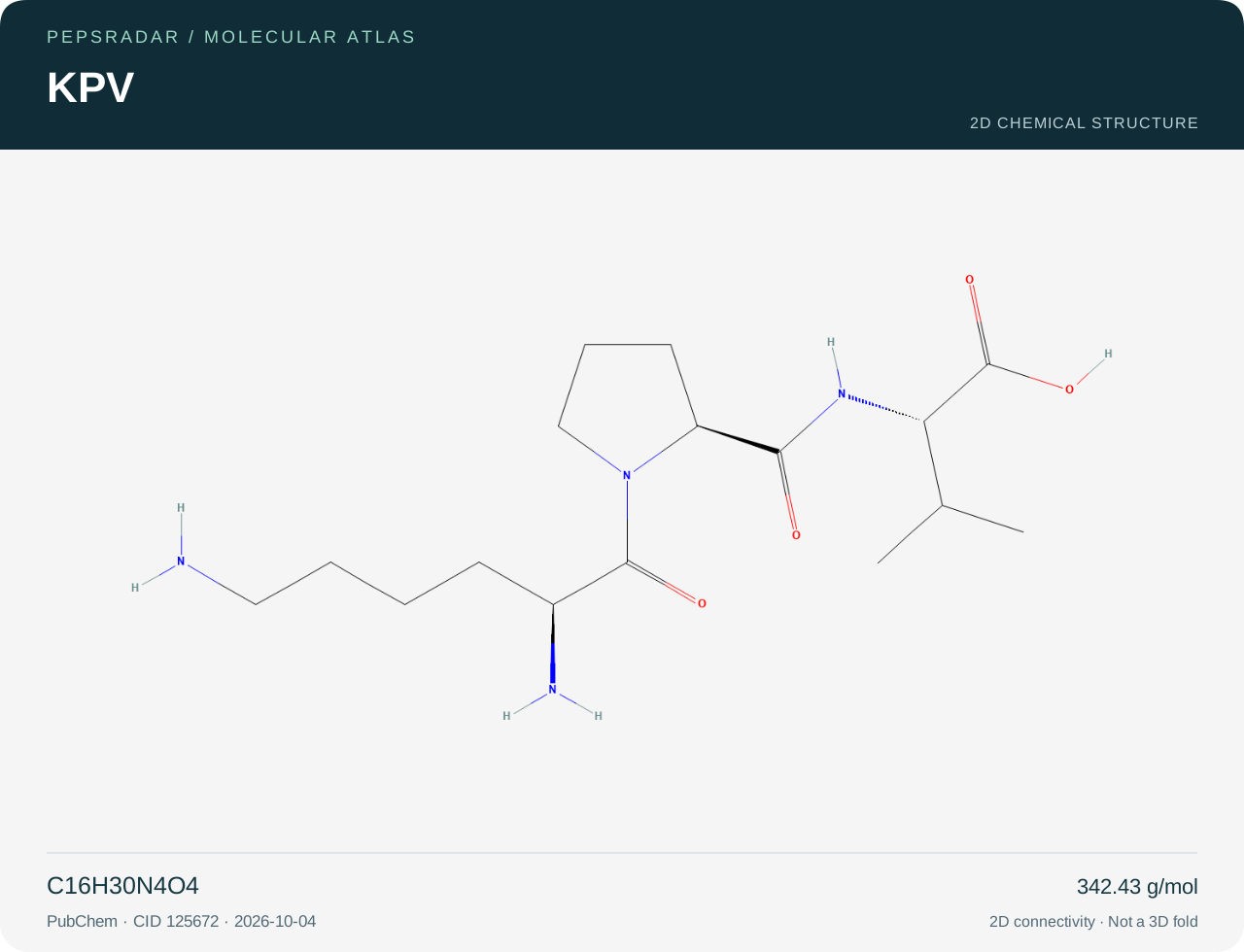
- Lysine–proline–valine tripeptide
- Main research area
- Intestinal inflammatory signaling
- Evidence featured
- Cell and mouse experiments
- Source check
- October 4, 2026
Source: PepT1-mediated tripeptide KPV uptake reduces intestinal inflammation. ↗
Molecular structure
Mechanism & research rationale
The selected work links cellular uptake through PepT1 to reduced inflammatory signaling. It combines transport experiments with chemically induced colitis models.
Source: PepT1-mediated tripeptide KPV uptake reduces intestinal inflammation. ↗
Research context & status
This is preclinical inflammation research. Mouse-colitis findings cannot establish treatment of Crohn disease, ulcerative colitis, or nonspecific digestive symptoms in people.
Source: PepT1-mediated tripeptide KPV uptake reduces intestinal inflammation. ↗
What does the evidence show?
Selected published evidence, with the population, findings, and limits kept together. These original summaries draw on publication abstracts; they are not a systematic review.
Cell and mouse experiments · 2008
PepT1 and intestinal inflammation
PepT1-mediated tripeptide KPV uptake reduces intestinal inflammation.
- Population / model
- Intestinal epithelial and immune cells, plus two chemically induced mouse-colitis models.
- Study design
- Transport assays, inflammatory signaling measurements, and oral exposure in mice.
- Main finding
- KPV uptake involved PepT1; inflammatory signaling and cytokine release decreased. Colitis measures improved in the mouse experiments.
- Limits & context
- The experiments support a transport/mechanism hypothesis. They do not establish clinical remission, mucosal healing, or a safe treatment regimen in people with inflammatory bowel disease.
Source: PepT1-mediated tripeptide KPV uptake reduces intestinal inflammation. ↗
Animal / laboratory study · 2017
Targeted KPV nanoparticles
Did an engineered delivery system change experimental colitis outcomes?
- Population / model
- Intestinal cell experiments and a mouse colitis model.
- Study design
- KPV in hyaluronic-acid-coated nanoparticles within a hydrogel was compared with a nanoparticle system without the same targeting coating.
- Main finding
- The targeted system delivered KPV to epithelial cells and macrophages. In mice, it reduced mucosal damage and TNF-alpha more strongly than the comparison delivery system.
- How to read it
- Delivery technology was central to the experiment; these were not ordinary KPV capsules or vials.
- Limits & context
- This is preclinical evidence, not a clinical ulcerative-colitis trial. Cell compatibility does not establish human safety, and the findings cannot be transferred to a different formulation or route.
Read the original paper for methods, adverse events, funding, and conflicts of interest. Publisher access may require a subscription.
Search additional PubMed records ↗New editorial updates
New source discoveries
Links appear automatically. Unreviewed discoveries are not verified medical findings.
Safety & precautions
Safety evidence & remaining uncertainty
FDA has identified a human-exposure evidence gap. Laboratory transport and inflammation assays do not resolve human tolerability or interactions.
Source: FDA · Peptide compounding safety concerns ↗
This is not a complete list of contraindications, interactions, or adverse effects. Medicine labels apply to specific products and indications; research-use listings are not interchangeable with approved medicines.
What are people discussing?
No editorial transcript note has been reviewed for this profile yet. Below are the matching video records available for exploration; title and caption matches are not verified claims.
Watch the source discussions
26 matching video records · 10 with captions indexed.
Across the full library, 30 caption files are indexed from 20,199 inventoried videos. Most transcripts remain unreviewed. Select a thumbnail or timestamp to watch inside PepsRadar. Thumbnail images load from YouTube.

Mind Pump Show
Hormones, Peptides & Body Transformation with Phil Vella CEO of Vita Bella Health | Mind Pump 2882 ↗
Captions indexed · Automatic matches need review

Mind Pump Show
Peptides vs Bioregulators: The Future of Health Optimization w/ Nick Andrews | Mind Pump 2672 ↗
Captions indexed · Automatic matches need review
Peptide Of The Week
Peptide of the Week: Gut Health Deep Dive With Liz Roman, The Poop Queen ↗
Captions indexed · Automatic matches need review

Peptide Of The Week
Peptide Q&A #59 – Warrior-Makers Wellness Center, HGH for Women & FOX-O4 vs Fasting ↗
Captions indexed · Automatic matches need review

Peptide Of The Week
Peptide Q&A #60 – Live from South Carolina, COA Verification, HGH Long Game & SIBO ↗
Captions indexed · Automatic matches need review

Peptide Of The Week
Telehealth vs Research Peptides: The Truth Nobody Tells You | Peptide of the Week Q&A #61 ↗
Captions indexed · Automatic matches need review
Sources & supplier listings
Listings are grouped by the vendor’s stated identity. Blends and modified derivatives are labeled separately. Inclusion is not a quality assessment or an endorsement.
KPV (10mg)
BioLongevity Labs · Vendor-labeled research use only
$99.97
Listed in stock · Snapshot 2026-10-04
Options may vary. Shipping and tax excluded.
Affiliate link · PepsRadar may earn a commission from purchases through this link. Affiliate disclosure.
KLOW Blend (GHK-Cu, BPC-157, TB-500, KPV) 80mg
BioLongevity Labs · Vendor-labeled research use only
$274.97
Listed in stock · Snapshot 2026-10-04
Options may vary. Shipping and tax excluded.
Blend ingredients & evidence →
View seller listing ↗Affiliate link · PepsRadar may earn a commission from purchases through this link. Affiliate disclosure.
KPV (10 mg)
American Peptides · Vendor-labeled research use only
$60.00
Listed in stock · Snapshot 2026-10-05
Options may vary. Shipping and tax excluded.
Affiliate link · PepsRadar may earn a commission from purchases through this link. Affiliate disclosure.
KPV (10 mg)
PSPeptides · Vendor-labeled research use only
$39.99
Listed in stock · Snapshot 2026-10-05
Options may vary. Shipping and tax excluded.
Affiliate link · PepsRadar may earn a commission from purchases through this link. Affiliate disclosure.
GHK-Cu + KPV Blend (60 mg - 50/10 mg)
PSPeptides · Vendor-labeled research use only
$59.99
Listed in stock · Snapshot 2026-10-05
Options may vary. Shipping and tax excluded.
Affiliate link · PepsRadar may earn a commission from purchases through this link. Affiliate disclosure.
Catalog checked 2026-10-04. Seller listings retain their stated intended use. Shops covered: BioLongevity Labs, BioLongevity Supplements, American Peptides, PSPeptides. This is not a market-wide comparison. Affiliate participation does not determine evidence or editorial coverage.
Questions worth asking
- What specific product, route, and research population does the claim refer to?
- Does the source measure an outcome in people, or only a laboratory marker?
- Cell and mouse colitis experiments do not establish an effective treatment for human inflammatory bowel disease.
- What adverse effects, uncertainty, and conflicts of interest does the original source report?
Frequently asked questions
Was the study a human inflammatory-bowel-disease trial?
No. It used cultured cells and mouse models.
Source: PepT1-mediated tripeptide KPV uptake reduces intestinal inflammation. ↗
Does reduced cytokine expression prove symptom relief?
No. Molecular markers, tissue healing, symptom control, and sustained remission are different endpoints.
Source: PepT1-mediated tripeptide KPV uptake reduces intestinal inflammation. ↗
References & editorial record
- FDA · Compounding safety concerns ↗
- PubMed · Cells and mouse colitis models · PMID 18061177 ↗
- Targeted KPV nanoparticles · 2017 ↗
Source notes checked 2026-10-04. Original PepsRadar summaries. Not reviewed by a medical professional. Topic grouping is editorial navigation, not a treatment recommendation. Video notes specify which excerpts were reviewed; no full transcripts are published.