 Peps

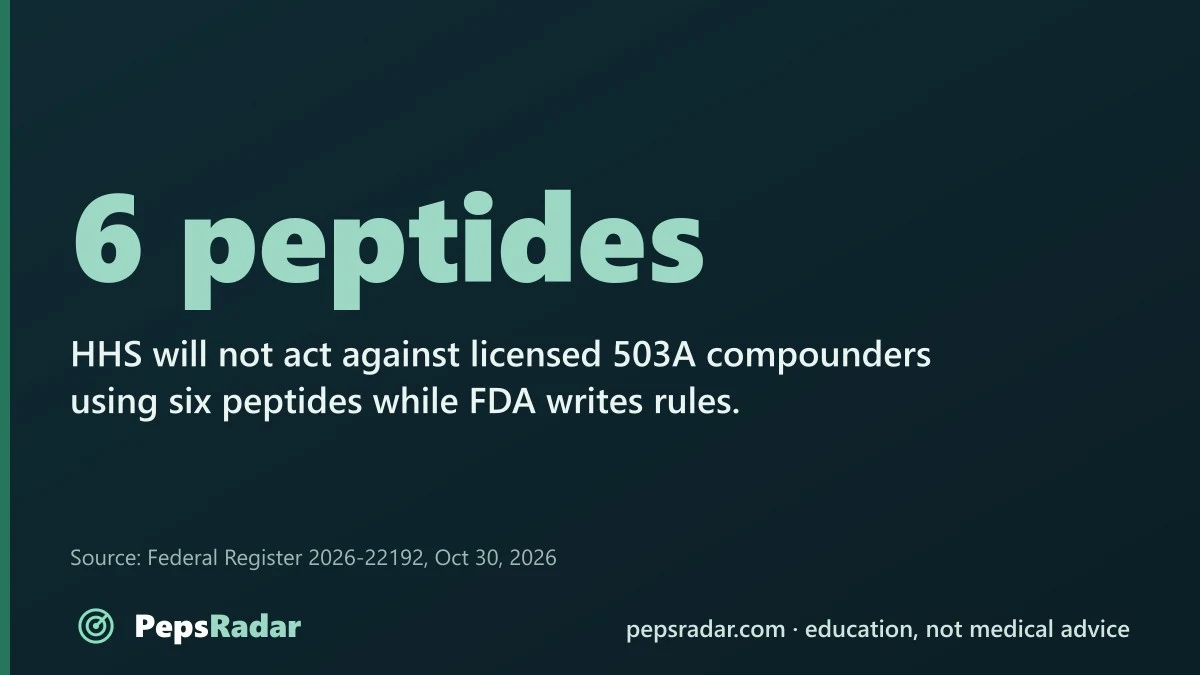
What HHS announced
On October 28, 2026, HHS filed a Federal Register notice (document 2026-22192, published October 30) announcing an "Enforcement Discretion Policy Regarding 503A Compounding Using Certain Peptide Bulk Drug Substances." HHS says it does not intend to take enforcement action against a state-licensed pharmacy, federal facility or licensed physician compounding a drug with a peptide listed in the policy's Appendix A.
The notice calls the policy a draft and an interim policy. It applies while FDA builds the 503A bulks list, the list of ingredients pharmacies may compound with under section 503A, through rulemaking. HHS says the policy is not binding on HHS or the public and may be revisited, in whole or in part, if a safety signal or product quality issue arises.
Source: Federal Register 2026-22192 (published Oct 30, 2026) ↗
Source: Federal Register public inspection: 2026-22192 (filed Oct 28, 2026) ↗
What it does not do
It is not FDA approval. The notice itself says compounded drugs are not FDA-approved, which means FDA does not review their safety, effectiveness or quality before they are marketed. It also does not place any peptide on the 503A bulks list; the notice says only that future FDA rulemaking may propose adding some or all of them.
Legal summaries of the full policy note two further limits: it does not apply to outsourcing facilities operating under section 503B, and products must still be compounded for a valid patient-specific prescription.
Source: Federal Register 2026-22192 (published Oct 30, 2026) ↗
The six peptides and their evidence
Appendix A names BPC-157, Epitalon, KPV, MOTS-c, Semax and TB-500. None is in an FDA-approved drug. All six sat in FDA's "Category 2" of compounding ingredients with possible safety risks until April 22, 2026. In July 2026, FDA staff concluded for each one that the evidence weighed against adding it to the bulks list, while FDA's advisory committee voted to recommend six of the seven peptides it reviewed. That vote is advisory.
BPC-157: FDA found no human studies by the oral, injected, nasal or skin routes, only two short enema studies. TB-500: FDA found no reports of it being given to patients for any condition. MOTS-c: effectiveness studies were limited to cells and rodents, and FDA cited a lack of human data. KPV: FDA found no information on its use in humans. Epitalon: FDA found no clinical data supporting its safety in humans. Semax: FDA found only two small effectiveness references with limited detail, and no human pharmacokinetic studies.
Source: Holland & Knight alert (Nov 4, 2026) ↗
Source: Drugs@FDA database ↗
Source: FDA PCAC briefing: BPC-157 (July 2026) ↗
Source: FDA PCAC briefing: TB-500 (July 2026) ↗
Source: FDA PCAC briefing: MOTS-c (July 2026) ↗
Source: FDA PCAC briefing: KPV (July 2026) ↗
What it means for consumers
The route the policy describes is a prescription from a licensed prescriber, filled by a state-licensed pharmacy or compounded by a licensed physician. Those products remain unapproved compounded drugs, and HHS has said it can change course if quality or safety problems appear.
The policy covers compounding only. It does not mention vials sold online as "research use only." FDA has previously said such a label does not change a product's status when evidence shows it is meant for people, and in 2023 called BPC-157 and TB-500 sold that way unapproved new drugs.
Source: Federal Register 2026-22192 (published Oct 30, 2026) ↗
Source: Holland & Knight alert (Nov 4, 2026) ↗
Source: FDA warning letter to a research-peptide seller (June 2023) ↗
What happens next
Long-term status will be settled by FDA rulemaking on the 503A bulks list, which may propose adding some or all of the six, or none. Until then, the policy is a statement of enforcement priorities that HHS can revise.
Written comments were open on regulations.gov under docket HHS-OASH-2026-0496 for two weeks after publication. The comment period closed at 11:59 p.m. Eastern on November 13, 2026; the docket showed 205 comments as of November 12.
This article summarizes public documents and is not legal or medical advice. PepsRadar does not give dosing or sourcing advice.
Source: Federal Register 2026-22192 (published Oct 30, 2026) ↗
Continue with the original research
Study examples are based on selected publication abstracts and the explicitly described source documents. This is not a systematic review or an individualized treatment guide. Editorial scope and methods.