 Peps
Peps
What is MOTS-c?
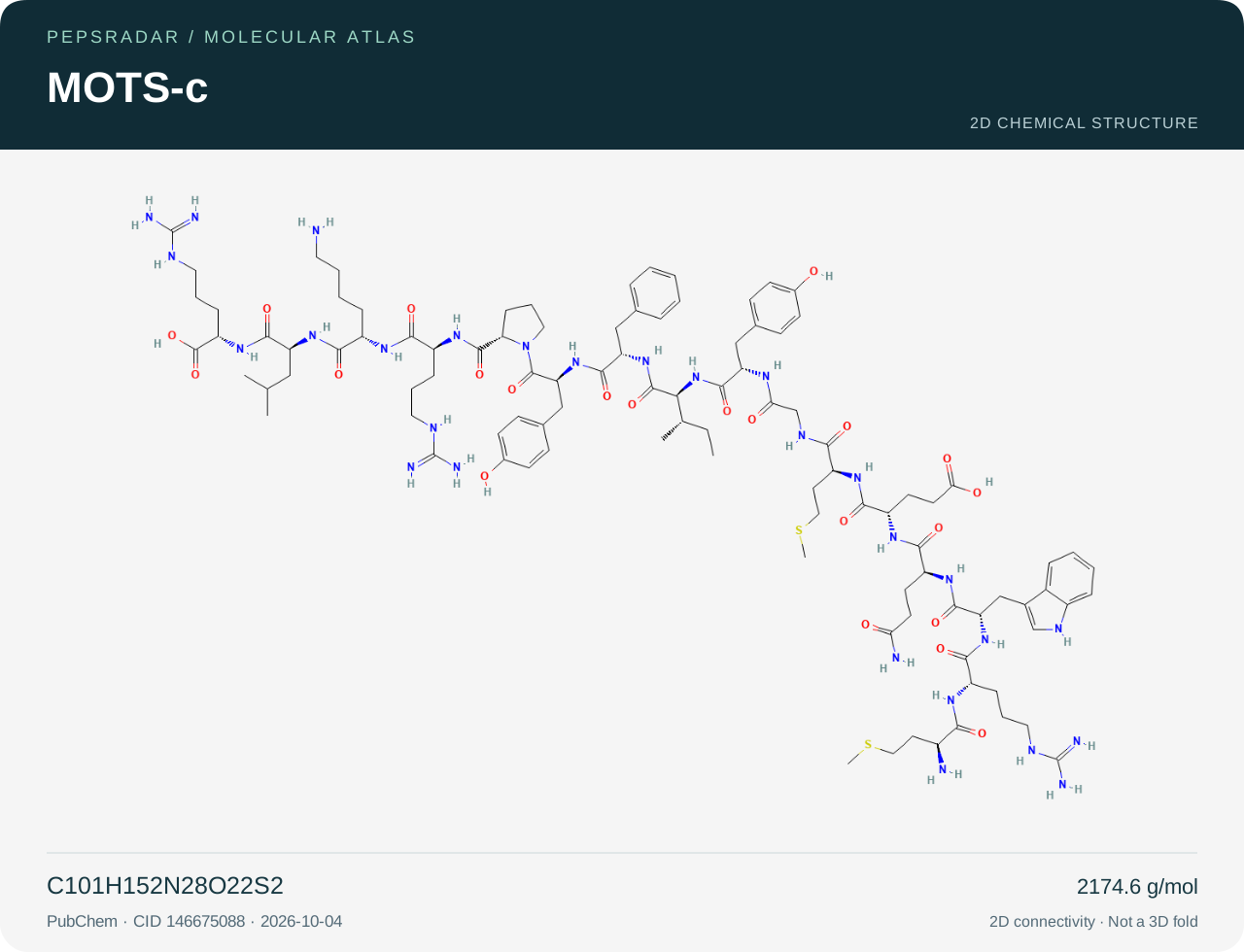
MOTS-c is a 16-amino-acid peptide studied as a mitochondrial signal. Its metabolic research is frequently discussed alongside exercise and aging.
Biological role or research focus
Mitochondrial signaling and metabolic research.
Experiments in cells and mice do not establish exercise replacement or weight-loss outcomes in people.
Role reference: The mitochondrial-derived peptide MOTS-c promotes metabolic homeostasis and reduces obesity and insulin resistance. ↗
Names you may encounter
MOTS C · MOTSC
Search terms can include brands, combinations, or historical names. They are not automatic product equivalents.
- Class / identity
- Mitochondrial-derived signaling peptide
- Main research area
- Metabolic stress responses
- Evidence featured
- Animal / laboratory study
- Source check
- October 4, 2026
Molecular structure
Mechanism & research rationale
The original study connected MOTS-c with folate/purine metabolism and activation of AMPK, a cellular energy-sensing pathway. That mechanism was explored in cells and mice.
Research context & status
The selected evidence is preclinical. It does not establish a human exercise substitute, weight-loss therapy, or treatment for diabetes.
What does the evidence show?
Selected published evidence, with the population, findings, and limits kept together. These original summaries draw on publication abstracts; they are not a systematic review.
Animal / laboratory study · 2015
Metabolic homeostasis study
The mitochondrial-derived peptide MOTS-c promotes metabolic homeostasis and reduces obesity and insulin resistance.
- Population / model
- Cell systems and mouse models of aging or high-fat feeding.
- Study design
- Mechanistic metabolic assays and treatment experiments in mice.
- Main finding
- MOTS-c affected folate/purine metabolism and AMPK signaling; treated mice were protected against some insulin-resistance and obesity phenotypes.
- Limits & context
- A mitochondrial origin does not establish a safe supplement or exercise replacement. This study did not test clinical weight loss or diabetes outcomes in humans.
Human observations + mouse experiments · 2021
Exercise-associated signaling and mouse physical performance
Were people given MOTS-c, or was their own peptide measured after exercise?
- Population / model
- Human exercise observations, cultured muscle cells, and young, middle-aged, and old mice.
- Study design
- The human component measured endogenous MOTS-c responses to exercise; administration experiments and late-life treatment were performed in mice.
- Main finding
- Exercise increased endogenous MOTS-c in human muscle and circulation. In mice, administered MOTS-c improved reported physical-performance measures across age groups; late-life experiments examined physical capacity and healthspan.
- How to read it
- The human observations and mouse interventions answer different questions. An exercise-associated biomarker change does not show that injecting the peptide improves human fitness.
- Limits & context
- The abstract does not report a randomized human MOTS-c treatment trial. Mouse physical-capacity or healthspan results cannot be relabeled as human lifespan extension.
Read the original paper for methods, adverse events, funding, and conflicts of interest. Publisher access may require a subscription.
Related records in our PubMed snapshot
MOTS-c in sepsis-induced cardiomyopathy: Mechanisms and translational potential. ↗
European journal of pharmacology · Issue date 2026 Oct 15 · Not appraised
MOTS-c, a mitochondrial-derived peptide, ameliorates lysosomal membrane permeability and improves survival of soft tissue transplantation. ↗
Autophagy · Issue date 2026 Oct · Not appraised
New editorial updates
New source discoveries
Links appear automatically. Unreviewed discoveries are not verified medical findings.
Safety & precautions
Safety evidence & remaining uncertainty
FDA reports a human-exposure evidence gap. Endogenous signaling does not establish the safety of externally administered commercial preparations.
Source: FDA · Peptide compounding safety concerns ↗
This is not a complete list of contraindications, interactions, or adverse effects. Medicine labels apply to specific products and indications; research-use listings are not interchangeable with approved medicines.
What are people discussing?
Myostatin and a proposed muscle pathway
The discussion refers to a rodent study while connecting MOTS-c, mitochondria, and myostatin. The exact study behind the numerical claim has not been verified for this note.
Which primary paper supports the claim, and were the outcomes measured in rodents or people?
Caption excerpt reviewed · Claims not independently verified · 2026-10-04
Original episode: The Best Peptide to Truly Lose Fat is Not GLP-1, it’s MOTS-C to Boost Mitochondria
Watch the source discussions
47 matching video records · 5 with captions indexed.
Across the full library, 30 caption files are indexed from 20,199 inventoried videos. Most transcripts remain unreviewed. Select a thumbnail or timestamp to watch inside PepsRadar. Thumbnail images load from YouTube.

Fouad Abiad Media
BURN FAT FASTER WITH MOTS C | Josh Holyfield | Real Bodybuilding Podcast ↗
Captions indexed · Automatic matches need review

Fouad Abiad Media
RETATRUTIDE: EVERYTHING YOU NEED TO KNOW | Wes Christensen | Fouad Abiad's Real Bodybuilding Podcast ↗
Captions indexed · Automatic matches need review

Mind Pump Show
Hormones, Peptides & Body Transformation with Phil Vella CEO of Vita Bella Health | Mind Pump 2882 ↗
Captions indexed · Automatic matches need review

Thomas DeLauer
The Best Peptide to Truly Lose Fat is Not GLP-1, it’s MOTS-C to Boost Mitochondria ↗
Captions indexed · Automatic matches need review
Dr. Trevor Bachmeyer
BPC-157: The Forever Peptide I Take Every Single Day - Dr Trevor Bachmeyer ↗
Captions indexed · Automatic matches need review

Biohackingturkey
MOTS-c Dosage Controversy: Must Watch Before You Start! ↗
Title match · Captions not indexed
Sources & supplier listings
Listings are grouped by the vendor’s stated identity. Blends and modified derivatives are labeled separately. Inclusion is not a quality assessment or an endorsement.
MOTS-c (10mg)
BioLongevity Labs · Vendor-labeled research use only
$109.97
Listed in stock · Snapshot 2026-10-04
Options may vary. Shipping and tax excluded.
Affiliate link · PepsRadar may earn a commission from purchases through this link. Affiliate disclosure.
NAD+ / MOTS-c / 5-Amino-1MQ Blend – 120mg (100mg / 10mg / 10mg)
BioLongevity Labs · Vendor-labeled research use only
$299.99
Listed in stock · Snapshot 2026-10-04
Options may vary. Shipping and tax excluded.
Blend ingredients & evidence →
View seller listing ↗Affiliate link · PepsRadar may earn a commission from purchases through this link. Affiliate disclosure.
MOTS-C (10 mg / 40 mg)
American Peptides · Vendor-labeled research use only
$100.00–$160.00
Listed in stock · Snapshot 2026-10-05
Options may vary. Shipping and tax excluded.
Affiliate link · PepsRadar may earn a commission from purchases through this link. Affiliate disclosure.
MOTS-C (10 mg / 50 mg)
PSPeptides · Vendor-labeled research use only
$69.99–$189.99
Listed in stock · Snapshot 2026-10-05
Options may vary. Shipping and tax excluded.
Affiliate link · PepsRadar may earn a commission from purchases through this link. Affiliate disclosure.
Catalog checked 2026-10-04. Seller listings retain their stated intended use. Shops covered: BioLongevity Labs, BioLongevity Supplements, American Peptides, PSPeptides. This is not a market-wide comparison. Affiliate participation does not determine evidence or editorial coverage.
Questions worth asking
- What specific product, route, and research population does the claim refer to?
- Does the source measure an outcome in people, or only a laboratory marker?
- Experiments in cells and mice do not establish exercise replacement or weight-loss outcomes in people.
- What adverse effects, uncertainty, and conflicts of interest does the original source report?
Frequently asked questions
Did this paper show that people could replace exercise?
No. That claim was not tested.
Does mitochondrial origin mean better energy in people?
It identifies a biological origin and hypothesis. Patient fatigue, exercise capacity, and long-term outcomes need clinical measurement.
What does the additional research establish?
The human observations and mouse interventions answer different questions. An exercise-associated biomarker change does not show that injecting the peptide improves human fitness. The abstract does not report a randomized human MOTS-c treatment trial. Mouse physical-capacity or healthspan results cannot be relabeled as human lifespan extension.
References & editorial record
- FDA · Compounding safety concerns ↗
- MOTS-c metabolic study (2015) ↗
- Reynolds et al. · Nature Communications · 2021 ↗
Source notes checked 2026-10-04. Original PepsRadar summaries. Not reviewed by a medical professional. Topic grouping is editorial navigation, not a treatment recommendation. Video notes specify which excerpts were reviewed; no full transcripts are published.
PUT THE EVIDENCE IN CONTEXT
Research guides

RESEARCH FIELD GUIDE
From a promising mechanism to a useful finding
A practical way to read peptide research without turning an interesting experiment into a clinical promise.
Read the guide →RESEARCH FIELD GUIDE
MOTS-c and exercise: what happened in people, and what happened in mice
One paper can contain several kinds of evidence. An exercise-associated signal is different from a human treatment result.
Read the guide →