 Peps
Two different things share one label
"Mitochondrial peptide" gets used for two unrelated groups. Mitochondrial-derived peptides are made by the body itself: they are encoded by short stretches of DNA inside the mitochondria, and humanin and MOTS-c are the best-known examples. MOTS-c, described in 2015, is a 16-amino-acid peptide coded within a mitochondrial ribosomal RNA gene.
Elamipretide, also called SS-31, is something else: a synthetic four-amino-acid peptide that interacts with cardiolipin, a fat in the inner mitochondrial membrane. It is a drug designed to act on mitochondria, not a natural signal they release, and its evidence looks nothing like the other two.
Source: Fuku et al., Aging Cell 2015 ↗
MOTS-c: strong mouse data, human data mostly measurement
In mice, MOTS-c treatment prevented diet-induced obesity and insulin resistance linked to age and a high-fat diet. A 2021 study reported better physical performance in young, middle-aged and old mice, and more physical capacity and healthspan when treatment started late in life.
The human part of that 2021 study measured people's own MOTS-c: exercise raised it in muscle and blood. Nobody was given the peptide. Other human work is observational too. In an 85-person study, blood MOTS-c did not differ between people with obesity and people of normal weight; it fell with age and rose with insulin resistance. None of these is a randomized treatment trial in people (our MOTS-c and exercise guide covers that question in more depth).
Humanin: protective in cells, a mixed biomarker in people
Humanin was discovered in 2001 when it protected cultured nerve cells from death caused by several Alzheimer's-linked genes and amyloid-beta, though not from every insult tested. A 2009 rodent study found that humanin and stronger synthetic versions improved insulin sensitivity, and that circulating humanin declined with age in humans and mice.
Larger human data complicate that picture. Among 693 people aged 21 to 113, plasma humanin rose with age and was highest in centenarians, and higher levels went with worse measures such as weaker handgrip in 70-year-olds. A later study from the same group found humanin lower in Alzheimer's disease but not in type 2 diabetes. These studies measured humanin; none gave it to people.
Source: Humanin: a novel central regulator of peripheral insulin action. ↗
Source: Conte et al., J Gerontol A 2019 ↗
Source: Conte et al., GeroScience 2021 ↗
Elamipretide: real trials, mixed results
Elamipretide has been through placebo-controlled trials. In Barth syndrome, a rare genetic disorder of cardiolipin, the TAZPOWER trial randomized 12 people and met neither main goal (a six-minute walk test and a symptom score) in its blinded phase. In the open-label extension, 10 patients continued and 8 reached week 168, with walking distance improving and injection-site reactions the most common side effect. That phase had no placebo group for comparison.
Larger trials in other conditions missed their main goals. MMPOWER-3 randomized 218 adults with primary mitochondrial myopathy and found no improvement in walking distance or fatigue at 24 weeks, though the drug was well tolerated. PROGRESS-HF, in 71 people with heart failure, found no improvement in heart volume after four weeks.
Source: Thompson et al., Genetics in Medicine 2024 (TAZPOWER extension) ↗
Where each stands with FDA and WADA
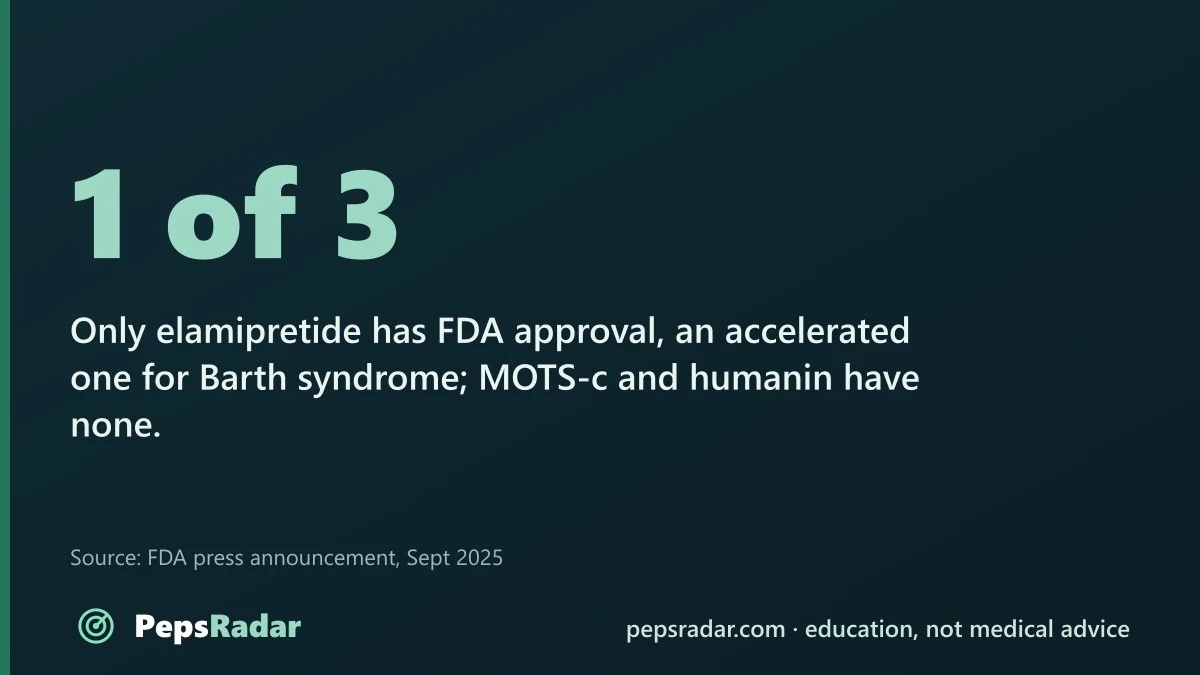
On September 19, 2025, FDA granted Forzinity (elamipretide) accelerated approval as the first treatment for Barth syndrome, to improve muscle strength. The decision rests on knee-extensor strength, a measure FDA judged reasonably likely to predict real benefit, and the company must run a confirmatory randomized, placebo-controlled trial. The approval does not cover "research" SS-31: FDA warning letters in August 2026 called SS-31 products from research-peptide sellers unapproved new drugs.
Neither MOTS-c nor humanin is FDA-approved. MOTS-c sat in FDA's 503A Category 2 (significant safety risks, including possible immunogenicity) until its nominations were withdrawn. On October 28, 2026, HHS said it would not act against licensed pharmacies or physicians compounding certain peptides, MOTS-c among them, while rulemaking proceeds; that is not approval. Humanin is not on FDA's 503A category lists. WADA's 2026 list names MOTS-c as a banned metabolic modulator, and humanin likely falls under its non-approved substances class.
Source: FDA press announcement, Sept 2025 ↗
Source: FDA warning letter, Aug 2026 ↗
Source: FDA 503A Category 2 safety-risk page ↗
Source: HHS enforcement discretion notice, Federal Register 2026 ↗
Source: FDA 503A bulk substance category lists ↗
Source: WADA 2026 Prohibited List ↗
Bottom line
Of the three, only elamipretide has controlled human trials and an FDA approval, and even that is narrow: one rare disease, an accelerated pathway still awaiting confirmation, and negative main results in larger trials elsewhere. MOTS-c and humanin are interesting natural signals, and researchers have proposed that raising their levels might help with aging, but the human evidence so far is mostly blood levels and associations.
PepsRadar gives no dosing or sourcing advice. Anyone weighing these compounds should talk with a licensed clinician.
Source: Shirley, Drugs 2026 (Elamipretide: First Approval) ↗
Continue with the original research
Study examples are based on selected publication abstracts and the explicitly described source documents. This is not a systematic review or an individualized treatment guide. Editorial scope and methods.