 Peps
Peps
What is AOD-9604?
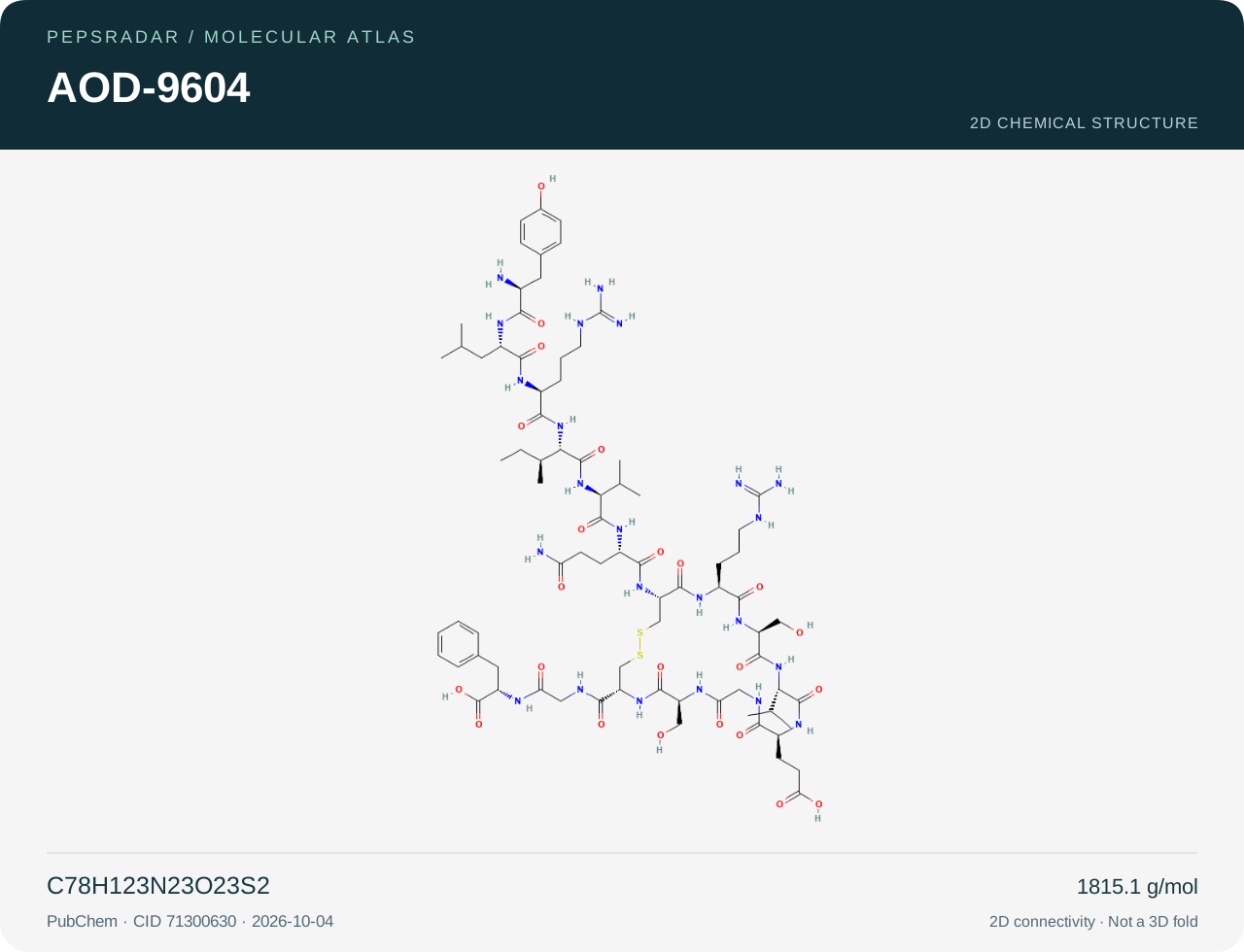
AOD-9604 is a modified fragment of growth hormone investigated for metabolic effects. Animal experiments and the later human obesity program tell different parts of its story.
Biological role or research focus
Growth-hormone fragment studied for obesity.
A fragment is not interchangeable with growth hormone. Research into fat metabolism does not establish effective weight loss.
Names you may encounter
AOD 9604 · AOD9604
Search terms can include brands, combinations, or historical names. They are not automatic product equivalents.
- Class / identity
- Modified growth-hormone fragment
- Main research area
- Fat metabolism research
- Evidence featured
- Animal / laboratory study
- Source check
- October 4, 2026
Molecular structure
Mechanism & research rationale
Early experiments examined fat oxidation and fat breakdown. AOD-9604 did not activate the tested growth-hormone receptor in the way intact growth hormone did, so it should not be treated as a smaller interchangeable version of that hormone.
Research context & status
The FDA’s 2024 assessment describes an unsuccessful obesity-development program. In the OPTIONS study, 536 people enrolled and 502 were randomized; oral AOD-9604 did not significantly outperform placebo at the primary weight-loss endpoint. This is a regulatory account of an unpublished study, not a peer-reviewed trial article.
What does the evidence show?
Selected published evidence, with the population, findings, and limits kept together. These original summaries draw on publication abstracts; they are not a systematic review.
Animal / laboratory study · 2001
Fat oxidation experiment
Increase of fat oxidation and weight loss in obese mice caused by chronic treatment with human growth hormone or a modified C-terminal fragment.
- Population / model
- Obese and lean mice, plus cells expressing the human growth-hormone receptor.
- Study design
- 14 days comparing AOD-9604, growth hormone, and saline; metabolic and receptor assays.
- Main finding
- AOD-9604 reduced weight gain and increased fat oxidation in obese mice. Unlike growth hormone, it did not activate the tested growth-hormone receptor or produce the same glucose effects.
- Limits & context
- These animal results generated a hypothesis. They do not establish effective human obesity treatment, nor validate a commercial injectable preparation.
Animal study · 2015
AOD9604 with and without hyaluronic acid in knee OA
Was cartilage damage affected in a chemically induced joint model?
- Population / model
- 32 mature rabbits with collagenase-induced knee osteoarthritis.
- Study design
- Four groups received joint injections of saline, hyaluronic acid, AOD9604, or their combination; morphology, histology, and lameness assessed.
- Main finding
- The active groups had better reported cartilage-damage scores than saline. The combination group had better scores than either single agent and a shorter lameness period.
- How to read it
- This is a distinct preclinical joint-research question. It does not overturn the limitations of the human weight-loss program.
- Limits & context
- Chemically induced rabbit OA and local joint exposure do not establish human cartilage regeneration, clinical arthritis benefit, or effective obesity treatment.
Source: Kwon and Park · Annals of Clinical & Laboratory Science · 2015 ↗
Read the original paper for methods, adverse events, funding, and conflicts of interest. Publisher access may require a subscription.
Search additional PubMed records ↗New editorial updates
New source discoveries
Links appear automatically. Unreviewed discoveries are not verified medical findings.
Safety & precautions
Safety evidence & remaining uncertainty
The FDA assessment highlights uncertain safety and product-characterization issues. Oral trial experience cannot establish the safety of an injected preparation; a route change can alter exposure and risk.
Source: FDA briefing: AOD-9604 and obesity ↗
This is not a complete list of contraindications, interactions, or adverse effects. Medicine labels apply to specific products and indications; research-use listings are not interchangeable with approved medicines.
What are people discussing?
No editorial transcript note has been reviewed for this profile yet. Below are the matching video records available for exploration; title and caption matches are not verified claims.
Watch the source discussions
39 matching video records · 1 with captions indexed.
Across the full library, 30 caption files are indexed from 20,199 inventoried videos. Most transcripts remain unreviewed. Select a thumbnail or timestamp to watch inside PepsRadar. Thumbnail images load from YouTube.

Trevor Kruder
Episode 15: Peptides Explained: Sourcing, Quality & Women’s Health | Ginger Lichlyter ↗
Captions indexed · Automatic matches need review
Dr. Jones, DC
AOD 9604 has amazing benefits, some of which are increased metabolism and fat mobilization. ↗
Title match · Captions not indexed

Dr. Jones, DC
AOD-9604 A Weight Loss Peptide | Dr. Jones, DC ↗
Title match · Captions not indexed

Dr. Jones, DC
AOD-9604 does what? #aod9604 #peptide #weightloss #health #fatburn #coloradomedicalsolutions ↗
Title match · Captions not indexed

Dr. Jones, DC
AOD-9604 Sounds Simple #fatloss #peptidetherapy ↗
Title match · Captions not indexed
Dr. Jones, DC
AOD-9604 Timing Matters #peptidetherapy #fatloss ↗
Title match · Captions not indexed
Sources & supplier listings
Listings are grouped by the vendor’s stated identity. Blends and modified derivatives are labeled separately. Inclusion is not a quality assessment or an endorsement.
AOD-9604 (5 mg)
American Peptides · Vendor-labeled research use only
$60.00
Listed in stock · Snapshot 2026-10-05
Options may vary. Shipping and tax excluded.
Affiliate link · PepsRadar may earn a commission from purchases through this link. Affiliate disclosure.
AOD-9604 (5 mg)
PSPeptides · Vendor-labeled research use only
$39.99
Listed in stock · Snapshot 2026-10-05
Options may vary. Shipping and tax excluded.
Affiliate link · PepsRadar may earn a commission from purchases through this link. Affiliate disclosure.
Catalog checked 2026-10-04. Seller listings retain their stated intended use. Shops covered: BioLongevity Labs, BioLongevity Supplements, American Peptides, PSPeptides. This is not a market-wide comparison. Affiliate participation does not determine evidence or editorial coverage.
Questions worth asking
- What specific product, route, and research population does the claim refer to?
- Does the source measure an outcome in people, or only a laboratory marker?
- A fragment is not interchangeable with growth hormone. Research into fat metabolism does not establish effective weight loss.
- What adverse effects, uncertainty, and conflicts of interest does the original source report?
Frequently asked questions
Why do mouse results and human results differ?
Species, metabolism, exposure, and study endpoints differ. Reduced weight gain in a short mouse experiment does not predict meaningful weight loss in a human trial.
Does “growth-hormone fragment” imply the same effects as growth hormone?
No. The cited receptor experiments found different behavior. Neither the name nor the fragment relationship establishes equivalent benefits.
What does the additional research establish?
This is a distinct preclinical joint-research question. It does not overturn the limitations of the human weight-loss program. Chemically induced rabbit OA and local joint exposure do not establish human cartilage regeneration, clinical arthritis benefit, or effective obesity treatment.
Source: Kwon and Park · Annals of Clinical & Laboratory Science · 2015 ↗
References & editorial record
- FDA · Compounding safety concerns ↗
- FDA briefing: AOD-9604 and obesity ↗
- Increase of fat oxidation and weight loss in obese mice caused by chronic treatment with human growth hormone or a modified C-terminal fragment. ↗
- Kwon and Park · Annals of Clinical & Laboratory Science · 2015 ↗
Source notes checked 2026-10-04. Original PepsRadar summaries. Not reviewed by a medical professional. Topic grouping is editorial navigation, not a treatment recommendation. Video notes specify which excerpts were reviewed; no full transcripts are published.