 Peps
Peps
What is Exenatide?
Exenatide is an incretin medicine used in type 2 diabetes. Short-acting and extended-release products need to be distinguished when reading evidence.
Biological role or research focus
Glucose-dependent insulin signaling.
Its established clinical context is type 2 diabetes, with formulation-specific precautions.
Role reference: MedlinePlus · Exenatide ↗
Names you may encounter
Byetta · Bydureon
Search terms can include brands, combinations, or historical names. They are not automatic product equivalents.
- Class / identity
- GLP-1 receptor agonist
- Main research area
- Type 2 diabetes
- Evidence featured
- Human randomized trial
- Source check
- October 4, 2026
Source: MedlinePlus · Exenatide ↗
Molecular structure
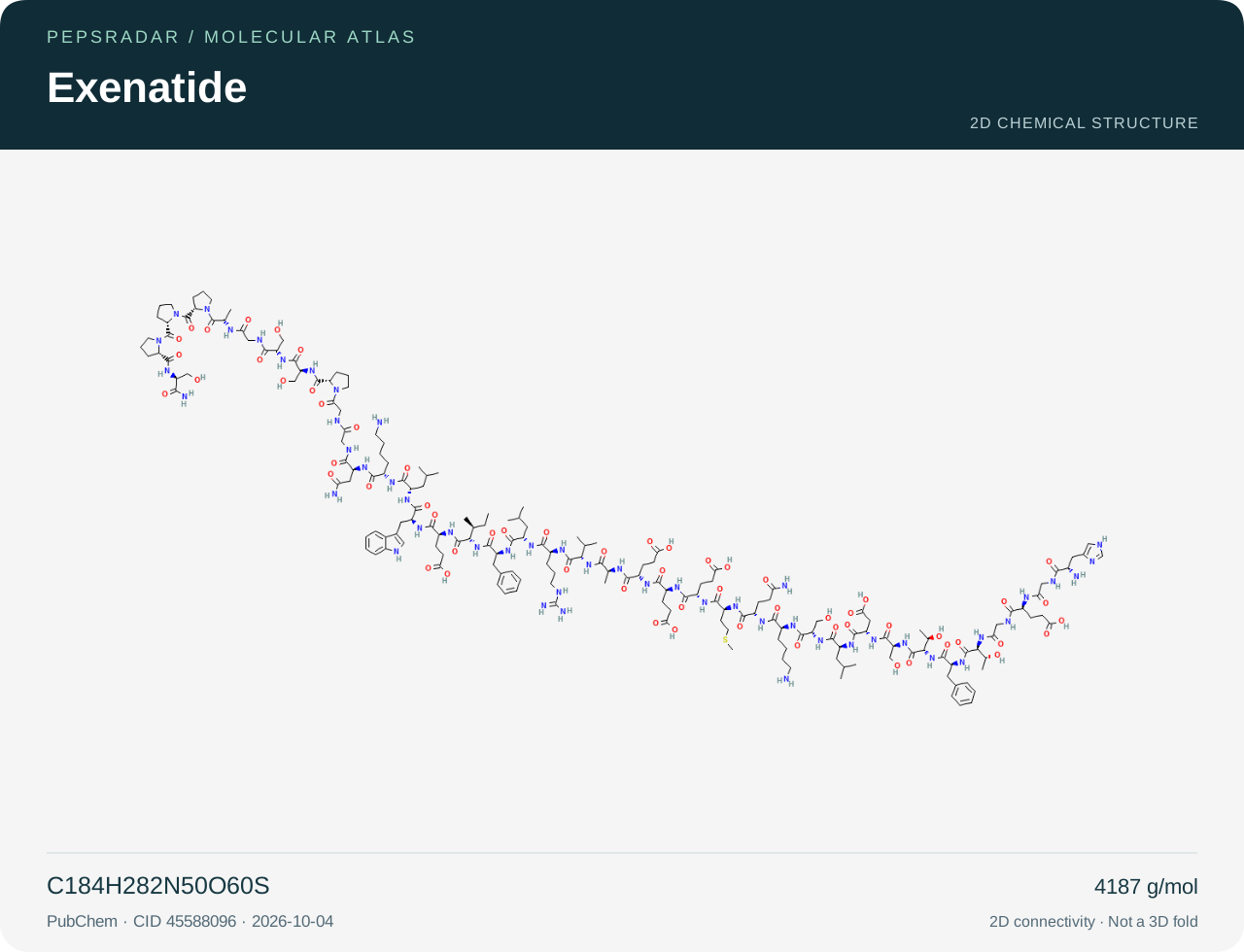
Mechanism & research rationale
It promotes insulin release when glucose is elevated. This supports glucose management, but does not by itself establish a reduction in cardiovascular events.
Source: MedlinePlus · Exenatide ↗
Clinical uses & product context
The medication reference describes diabetes care alongside diet and exercise. EXSCEL specifically tested a once-weekly preparation for cardiovascular outcomes; its safety finding should not be relabeled as a demonstrated superiority benefit.
Source: MedlinePlus · Exenatide ↗
What does the evidence show?
Selected published evidence, with the population, findings, and limits kept together. These original summaries draw on publication abstracts; they are not a systematic review.
Human randomized trial · 2017
EXSCEL
Effects of Once-Weekly Exenatide on Cardiovascular Outcomes in Type 2 Diabetes.
- Population / model
- 14,752 adults with type 2 diabetes.
- Study design
- Once-weekly exenatide versus placebo; cardiovascular outcomes followed over a median 3.2 years.
- Main finding
- The main cardiovascular composite occurred in 11.4% versus 12.2%; hazard ratio 0.91 (95% CI 0.83–1.00). Noninferiority was met, but superiority was not (P=0.06).
- How to read it
- The 0.8-percentage-point observed event difference is descriptive. The primary superiority test was not significant, so EXSCEL cannot be presented as a proven cardiovascular-event reduction.
- Limits & context
- Meeting a cardiovascular safety criterion is different from proving cardiovascular benefit. Results concern the once-weekly preparation and should not be relabeled as an obesity trial.
Source: Effects of Once-Weekly Exenatide on Cardiovascular Outcomes in Type 2 Diabetes. ↗
Human phase 3 randomized trial · 2025
Phase 3 Parkinson disease trial
Did extended-release exenatide slow Parkinson motor progression?
- Population / model
- 194 people aged 25–80 with Parkinson disease were randomized equally at six UK hospitals; 188 had follow-up data included in analyses.
- Study design
- Double-blind placebo comparison for 96 weeks on top of dopaminergic treatment. The primary motor score was assessed off dopaminergic medication.
- Main finding
- MDS-UPDRS part III off-medication scores worsened by 5.7 points with exenatide versus 4.5 with placebo. Adjusted treatment coefficient: 0.92 (95% CI −1.56 to 3.39; P=0.47). At least one serious adverse event occurred in 9% versus 11%.
- How to read it
- The larger phase 3 study did not support a disease-modifying effect in this population. Earlier mechanistic or small-study signals should be read alongside this negative result.
- Limits & context
- This result concerns exenatide, the studied population, and the specified endpoint. It does not prove that every GLP-1 agent has identical neurological effects. A nonsignificant result also does not prove exact equivalence or absence of rare harms.
Source: Exenatide phase 3 Parkinson trial · The Lancet · 2025 ↗
Read the original paper for methods, adverse events, funding, and conflicts of interest. Publisher access may require a subscription.
Search additional PubMed records ↗New editorial updates
New source discoveries
Links appear automatically. Unreviewed discoveries are not verified medical findings.
Safety & precautions
Key precautions
Gastrointestinal effects, pancreatitis concerns, kidney-related precautions, and medication interactions matter. Product-specific warnings may differ between preparations, so the exact label is essential.
Source: MedlinePlus · Exenatide ↗
This is not a complete list of contraindications, interactions, or adverse effects. Medicine labels apply to specific products and indications; research-use listings are not interchangeable with approved medicines.
What are people discussing?
No editorial transcript note has been reviewed for this profile yet. Below are the matching video records available for exploration; title and caption matches are not verified claims.
Watch the source discussions
1 matching video records · 1 with captions indexed.
Across the full library, 30 caption files are indexed from 20,199 inventoried videos. Most transcripts remain unreviewed. Select a thumbnail or timestamp to watch inside PepsRadar. Thumbnail images load from YouTube.

MAKE Wellness Official
The Peptide PhDs Podcast: When Peptides Attack! ↗
Captions indexed · Automatic matches need review
Sources & supplier listings
Listings are grouped by the vendor’s stated identity. Blends and modified derivatives are labeled separately. Inclusion is not a quality assessment or an endorsement.
We have not added a supplier for this profile. Missing products and coded listings are not filled with guesses.
Catalog checked 2026-10-04. Seller listings retain their stated intended use. Shops covered: BioLongevity Labs, BioLongevity Supplements, American Peptides, PSPeptides. This is not a market-wide comparison. Affiliate participation does not determine evidence or editorial coverage.
Questions worth asking
- Which indication and formulation does the source describe?
- Does the video make a broader claim than the source supports?
- Its established clinical context is type 2 diabetes, with formulation-specific precautions.
- What adverse effects, uncertainty, and conflicts of interest does the original source report?
Frequently asked questions
Did EXSCEL prove fewer cardiovascular events?
It met the prespecified noninferiority safety test, but not the superiority test.
Source: MedlinePlus · Exenatide ↗
Can all exenatide products be substituted by name?
No. Release characteristics and product instructions differ.
Source: Effects of Once-Weekly Exenatide on Cardiovascular Outcomes in Type 2 Diabetes. ↗
Can a promising GLP-1 mechanism establish treatment for Parkinson disease?
No. Laboratory rationale must be tested against clinical outcomes. The 2025 exenatide phase 3 trial did not demonstrate slowed motor progression at 96 weeks.
Source: Exenatide phase 3 Parkinson trial · The Lancet · 2025 ↗
Can the lixisenatide result replace the exenatide result?
No. These are different medicines, populations, durations, and assessment conditions. Separate trial results should remain attached to the studied compound.
Source: Exenatide phase 3 Parkinson trial · The Lancet · 2025 ↗
How complete is this evidence review?
This profile summarizes selected NLM abstracts and linked medicine information. It is not a systematic review. Full-text verification and a comprehensive search have not been done, and this summary has not been reviewed by a medical professional.
References & editorial record
- MedlinePlus · Exenatide ↗
- Effects of Once-Weekly Exenatide on Cardiovascular Outcomes in Type 2 Diabetes. ↗
- Exenatide phase 3 Parkinson trial · The Lancet · 2025 ↗
Source notes checked 2026-10-04. Original PepsRadar summaries. Not reviewed by a medical professional. Topic grouping is editorial navigation, not a treatment recommendation. Video notes specify which excerpts were reviewed; no full transcripts are published.