 Peps

Lab promise versus human trials
Search for "tissue repair peptides" and you will find long lists of compounds said to heal tendons, ligaments, skin and gut. Much of that reputation comes from cell dishes and rodents. This roundup asks a narrower question for each one: what has actually been measured in people?
The answer varies widely. A few compounds reached placebo-controlled trials. Others have almost no human record at all: for TB-500, the FDA says it "has not identified any human exposure data."
BPC-157: strong rat data, thin human data
BPC-157's healing reputation rests largely on rat studies. In a 2003 study, rats with a cut Achilles tendon that received BPC-157 showed better load to failure, function scores and tissue repair than controls. A 2010 study reported similar gains after the knee's medial collateral ligament was cut.
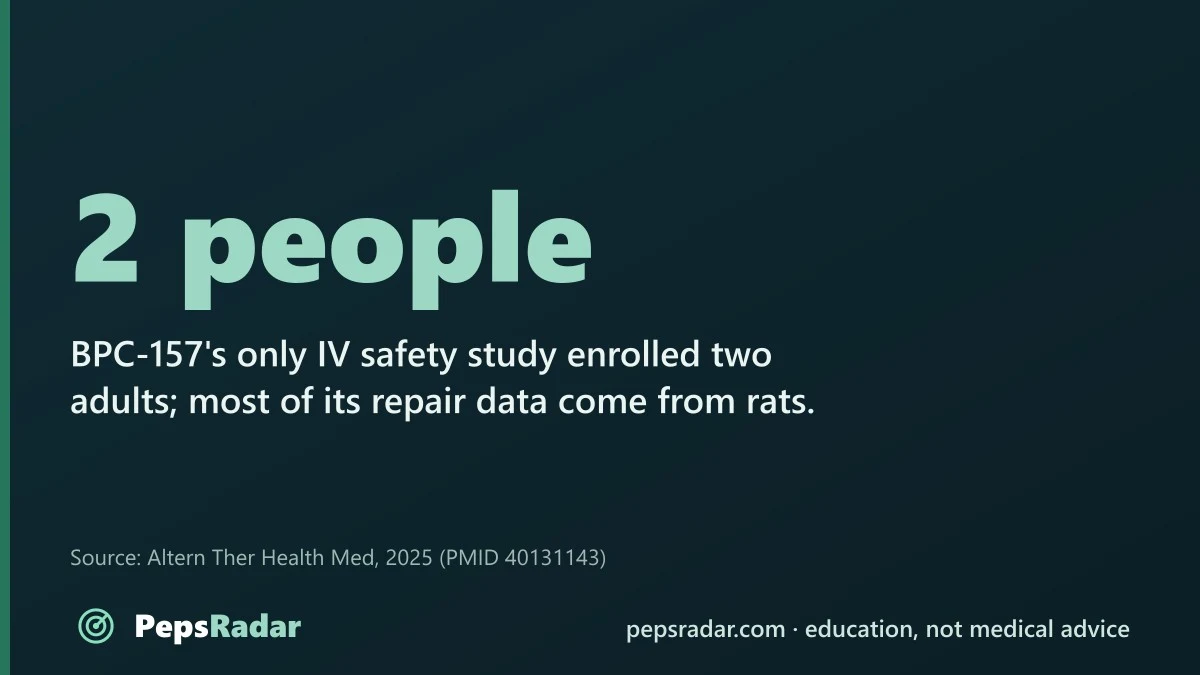
The human record is small. A 2021 chart review from one clinic phoned 16 patients after knee injections, and 14 said their pain improved, but there was no control group and no standard measurement tool. A 2025 IV safety pilot enrolled two adults who had both used it before and found no side effects or biomarker changes over three days. Neither study tested whether tissue heals faster.
Source: Pentadecapeptide BPC 157 (PL 14736) improves ligament healing in the rat. ↗
Source: Intra-Articular Injection of BPC 157 for Multiple Types of Knee Pain ↗
Source: Safety of Intravenous Infusion of BPC157 in Humans: A Pilot Study. ↗
Thymosin beta-4 and TB-500: the trials used the full protein
Thymosin beta-4 is a natural 43-amino-acid protein. TB-500 is a short fragment of it (the LKKTETQ sequence). The human trials tested the full protein, mostly as eye drops or a topical treatment.
In a 72-person dry-eye trial, neither main endpoint reached significance, though some secondary measures favored treatment. A smaller trial of nine patients with severe dry eye reported significant symptom and staining improvements. A 73-patient phase 2 trial in venous leg ulcers found safety comparable to placebo and suggested healing might be faster. These results do not automatically apply to the TB-500 fragment.
GHK-Cu: mostly skin and cosmetic studies
GHK-Cu, a copper-bound tripeptide, increased collagen and other wound-matrix components in a 1993 rat wound-chamber study. Its human evidence is mainly topical skin care. In a small randomized study after CO2 laser resurfacing, which 13 patients completed, blinded evaluators found no difference in redness, wrinkles or overall skin quality, although GHK-Cu users reported higher satisfaction.
Source: Effects of topical copper tripeptide complex on CO2 laser-resurfaced skin ↗
TP-508 and LL-37 went furthest, with mixed results; KPV is still in mice
TP-508 (Chrysalin), a thrombin-derived peptide, was tested in a 60-person placebo-controlled trial in diabetic foot ulcers. Among patients treated as planned, it more than doubled the rate of complete healing. A later broken-wrist trial that enrolled 274 people was stopped because treatment showed no benefit over placebo.
LL-37, a synthetic copy of a human antimicrobial peptide, was applied to hard-to-heal venous leg ulcers. A 34-person first-in-human trial reported faster healing at the two lower strengths, but the 148-patient phase 2b follow-up found no significant benefit across the full study population.
KPV has been studied in intestinal cells and mouse colitis models, where it reduced inflammatory signaling. FDA says it has not identified human exposure data for KPV products.
Source: TP-508 wrist fracture trial record ↗
Source: PepT1-mediated tripeptide KPV uptake reduces intestinal inflammation. ↗
Where regulators and anti-doping rules stand
None of these peptides is an FDA-approved drug. BPC-157, TB-500, KPV and LL-37 sat on FDA's list of compounding substances that may pose significant safety risks until nominators withdrew them. In October 2026, HHS published an interim policy saying it does not intend to take action against licensed pharmacies or physicians compounding certain peptides, including BPC-157, TB-500 and KPV. That is enforcement discretion, not approval. Non-injectable GHK-Cu is in FDA's category 1.
For athletes, WADA's 2026 Prohibited List names BPC-157 among non-approved substances and names thymosin beta-4 and its derivatives, such as TB-500, as growth factors. GHK-Cu, TP-508, KPV and LL-37 are not named, but unapproved substances are generally covered by the list's S0 catch-all.
Source: FDA compounding safety-risk list ↗
Source: HHS peptide enforcement policy (2026) ↗
Source: FDA 503A bulk substance categories ↗
Source: WADA 2026 Prohibited List ↗
Bottom line
Marketing often presents these compounds as proven healers. The human record is narrower: small-to-mid-size trials of thymosin beta-4, TP-508 and LL-37 with mixed results, cosmetic studies of GHK-Cu, and only uncontrolled reports for BPC-157. Animal results justify running trials; they do not show that a peptide repairs a human tendon or ligament.
PepsRadar does not give dosing or sourcing advice. For an injury that is not healing, a sports-medicine or wound-care clinician is the right starting point.
Source: Safety of Intravenous Infusion of BPC157 in Humans: A Pilot Study. ↗
Continue with the original research
Study examples are based on selected publication abstracts and the explicitly described source documents. This is not a systematic review or an individualized treatment guide. Editorial scope and methods.