 Peps
Peps
What is Lanreotide?
Lanreotide is a prescription somatostatin analogue used in specific endocrine and neuroendocrine conditions. Its evidence depends on the disease being treated.
Biological role or research focus
Somatostatin signaling in hormone-related conditions.
Acromegaly, neuroendocrine tumors, and carcinoid syndrome are specific clinical contexts.
Role reference: MedlinePlus · Lanreotide ↗
Names you may encounter
Somatuline
Search terms can include brands, combinations, or historical names. They are not automatic product equivalents.
- Class / identity
- Somatostatin analogue
- Main research area
- Hormonal suppression and selected tumors
- Evidence featured
- Human randomized trial
- Source check
- October 4, 2026
Source: MedlinePlus · Lanreotide ↗
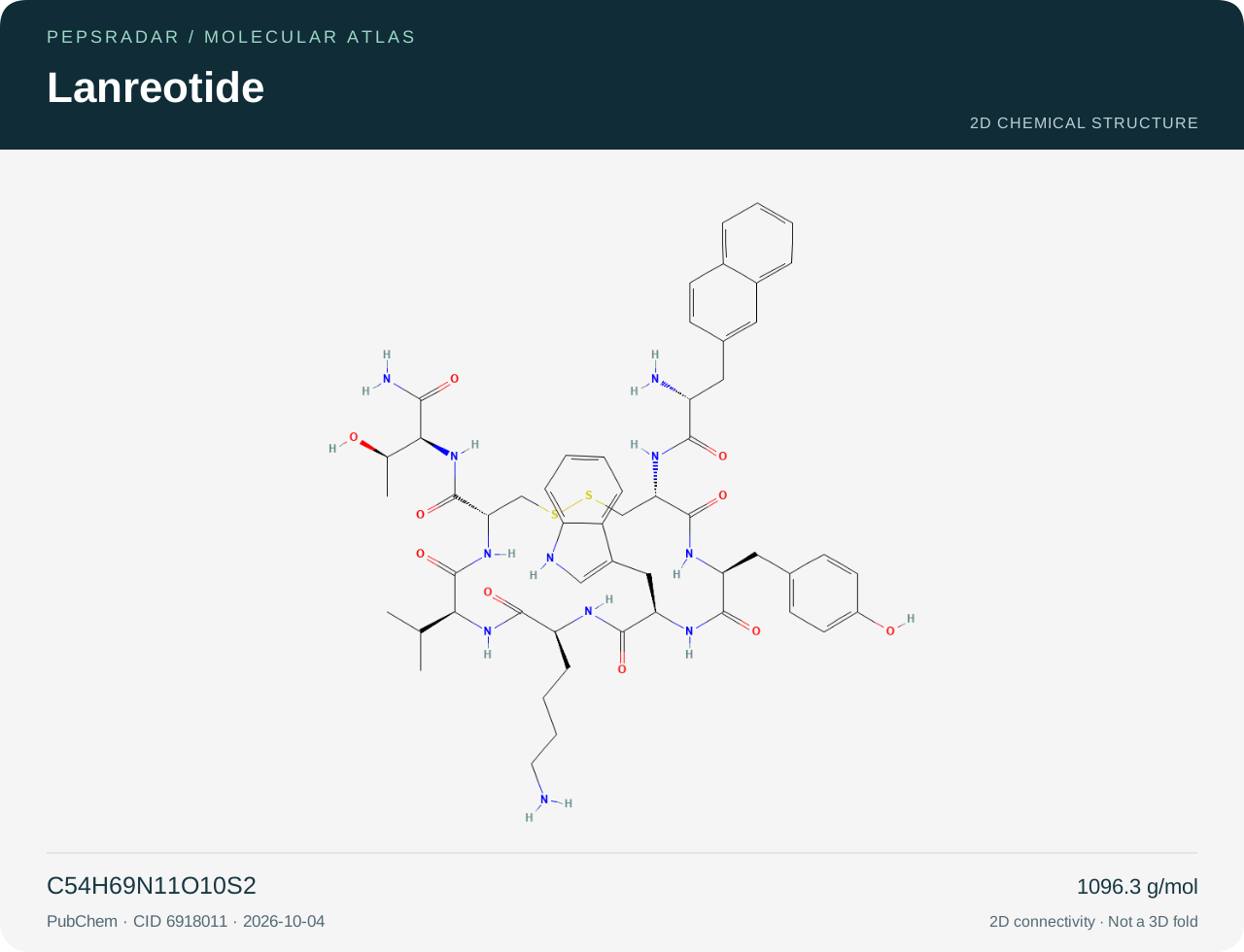
Molecular structure
Mechanism & research rationale
It reduces secretion of selected hormones and related signaling. In neuroendocrine tumors, receptor expression and tumor characteristics help define the relevant research population.
Source: MedlinePlus · Lanreotide ↗
Medicine status & clinical context
Lanreotide is a prescription somatostatin agonist used in specified acromegaly, gastroenteropancreatic neuroendocrine tumor, and carcinoid-syndrome settings. Hormone-symptom control and tumor-progression outcomes are different clinical questions.
The medication reference covers acromegaly, certain gastrointestinal or pancreatic neuroendocrine tumors, and carcinoid syndrome. Symptom control and tumor-progression control are different clinical aims.
What does the evidence show?
Selected published evidence, with the population, findings, and limits kept together. These original summaries draw on publication abstracts; they are not a systematic review.
Human randomized trial · 2014
CLARINET
Lanreotide in metastatic enteropancreatic neuroendocrine tumors.
- Population / model
- 204 patients with advanced, well/moderately differentiated, nonfunctioning, somatostatin-receptor-positive neuroendocrine tumors. Tumors were grade 1 or 2 with Ki-67 below 10%; 96% of participants had no progression in the preceding three to six months.
- Study design
- Lanreotide versus placebo for up to 96 weeks.
- Main finding
- Estimated progression-free survival at 24 months was 65.1% versus 33.0%; hazard ratio for progression or death 0.47. Overall survival and quality of life were not significantly different. The hazard ratio’s 95% CI was 0.30–0.73. Treatment-related diarrhea occurred in 26% versus 9%.
- How to read it
- The 24-month estimates differ by 32.1 percentage points. The hazard ratio concerns progression or death during follow-up; it is not a percentage of patients cured. Median progression-free survival was not reached in the lanreotide group versus 18 months with placebo.
- Limits & context
- The tumor subtype and receptor status are essential. Slowing progression is not the same as curing cancer, and cannot be generalized to unrelated tumors.
Source: Lanreotide in metastatic enteropancreatic neuroendocrine tumors. ↗
Read the original paper for methods, adverse events, funding, and conflicts of interest. Publisher access may require a subscription.
Further reading · 4 additional publication links
Exact-name PubMed search checked 2026-10-04. These records have not been appraised. A name match can include related compounds, combinations, or other formulations; it does not establish safety or benefit.
Lanreotide. ↗
· 2012 · Review
Lanreotide autogel/depot in advanced enteropancreatic neuroendocrine tumours: final results of the CLARINET open-label extension study. ↗
Endocrine · 2021 Feb · Journal Article, Research Support, Non-U.S. Gov't
Read available full text ↗
Lanreotide. ↗
· 2006 · Review
Carcinoid Syndrome. ↗
· 2025 Jan · Study Guide
New editorial updates
New source discoveries
Links appear automatically. Unreviewed discoveries are not verified medical findings.
Safety & precautions
Key precautions
Blood-glucose changes, gallbladder problems, digestive effects, and heart-rate concerns warrant attention. Other endocrine disorders and interacting medicines affect monitoring.
Source: MedlinePlus · Lanreotide ↗
CLARINET-specific adverse-event context
Treatment-related diarrhea was the most common reported adverse event: 26% with lanreotide versus 9% with placebo. This trial-specific comparison does not summarize all product precautions or long-term harms.
Source: Lanreotide in metastatic enteropancreatic neuroendocrine tumors. ↗
Official product context · checked October 4, 2026
Medication information highlights blood-sugar changes and gallbladder, pancreatic, cardiac, and other medical-history considerations. The exact indication and preparation determine the monitoring framework.
Source: MedlinePlus · Lanreotide injection ↗
This is not a complete list of contraindications, interactions, or adverse effects. Medicine labels apply to specific products and indications; research-use listings are not interchangeable with approved medicines.
What are people discussing?
No editorial transcript note has been reviewed for this profile yet. Below are the matching video records available for exploration; title and caption matches are not verified claims.
Watch the source discussions
0 matching video records · 0 with captions indexed.
Across the full library, 30 caption files are indexed from 20,199 inventoried videos. Most transcripts remain unreviewed. Select a thumbnail or timestamp to watch inside PepsRadar. Thumbnail images load from YouTube.
No matching video has been identified in the current snapshot.
Sources & supplier listings
Listings are grouped by the vendor’s stated identity. Blends and modified derivatives are labeled separately. Inclusion is not a quality assessment or an endorsement.
We have not added a supplier for this profile. Missing products and coded listings are not filled with guesses.
Catalog checked 2026-10-04. Seller listings retain their stated intended use. Shops covered: BioLongevity Labs, BioLongevity Supplements, American Peptides, PSPeptides. This is not a market-wide comparison. Affiliate participation does not determine evidence or editorial coverage.
Questions worth asking
- Which indication and formulation does the source describe?
- Does the video make a broader claim than the source supports?
- Acromegaly, neuroendocrine tumors, and carcinoid syndrome are specific clinical contexts.
- What adverse effects, uncertainty, and conflicts of interest does the original source report?
Frequently asked questions
Does CLARINET apply to all cancers?
No. It enrolled a narrowly characterized group of neuroendocrine tumors.
Source: MedlinePlus · Lanreotide ↗
Is progression-free survival the same as overall survival?
No. The first measures time without progression or death; the second measures survival itself. CLARINET did not show a significant overall-survival difference.
Source: Lanreotide in metastatic enteropancreatic neuroendocrine tumors. ↗
Why do receptor status and tumor grade matter?
CLARINET required somatostatin-receptor-positive tumors with Ki-67 below 10%. The effect estimate should not be generalized to high-grade, receptor-negative, or unrelated cancers.
Source: Lanreotide in metastatic enteropancreatic neuroendocrine tumors. ↗
Does “median not reached” mean progression never occurred?
No. It means the estimated progression-free survival curve had not reached 50% at that analysis. It does not mean there were no events, and censoring and follow-up affect the estimate.
Source: Lanreotide in metastatic enteropancreatic neuroendocrine tumors. ↗
What remains uncertain from this abstract?
Overall survival and quality-of-life differences were not significant. Small subgroup estimates had wide confidence intervals, so the overall result does not establish the same effect in every subgroup.
Source: Lanreotide in metastatic enteropancreatic neuroendocrine tumors. ↗
How complete is this evidence review?
This profile summarizes selected NLM abstracts and linked medicine information. It is not a systematic review. Full-text verification and a comprehensive search have not been done, and this summary has not been reviewed by a medical professional.
Does the official medicine reference cover every use discussed online?
No. The reference covers defined products and clinical settings. Research outside those uses needs separate evidence and does not extend the medicine’s authorization.
References & editorial record
Source notes checked 2026-10-04. Original PepsRadar summaries. Not reviewed by a medical professional. Topic grouping is editorial navigation, not a treatment recommendation. Video notes specify which excerpts were reviewed; no full transcripts are published.