 Peps
Peps
What is Cosyntropin?
Cosyntropin is a synthetic ACTH fragment used in adrenal testing. The selected research paper examined a separate experimental obstetric application after accidental dural puncture.
Biological role or research focus
Adrenal signaling and experimental obstetric use.
This is a small study in a specific procedural setting. It does not establish broad headache treatment, and the prevention results should not be confused with treating an existing headache.
Role reference: Cosyntropin for prophylaxis against postdural puncture headache after accidental dural puncture. · 2010 ↗
Names you may encounter
Tetracosactide · ACTH 1–24
Search terms can include brands, combinations, or historical names. They are not automatic product equivalents.
- Class / identity
- Synthetic ACTH fragment
- Research focus
- Adrenal signaling and experimental obstetric use
- Featured evidence
- Human randomized trial
- Source check
- October 4, 2026
Molecular structure
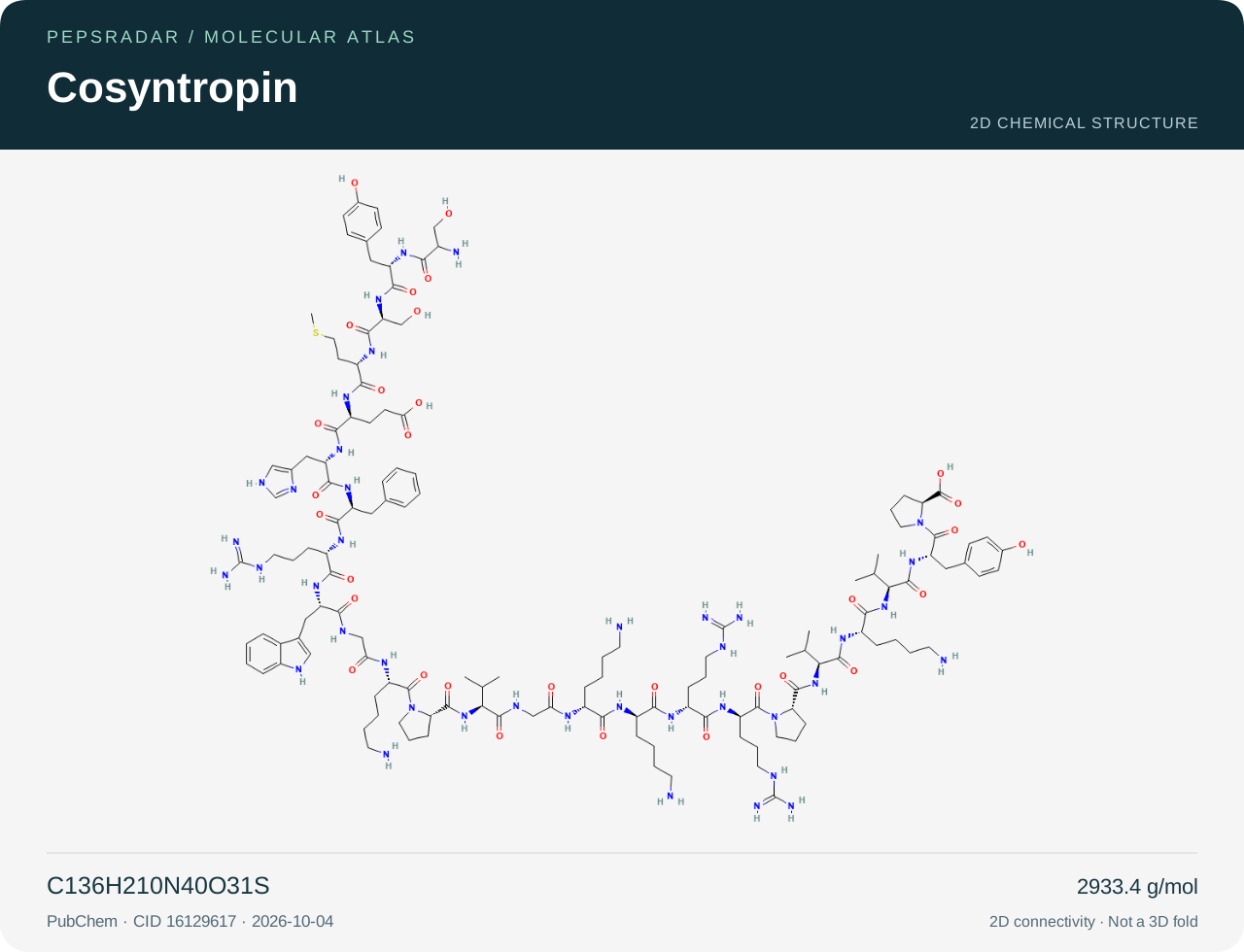
How Cosyntropin works
ACTH-related signaling stimulates the adrenal cortex. Its diagnostic use and the experimental headache-prevention question in this paper are distinct contexts.
Medicine status & clinical context
The linked U.S. label identifies cosyntropin as a diagnostic agent, used with other tests to screen for adrenocortical insufficiency in adults and children. The headache-prevention study on this page investigates a different use and does not redefine the labeled indication.
The featured trial is not a study establishing adrenal-test protocols. It examines post-dural-puncture headache prevention in a particular obstetric setting; it should not be presented as a general headache indication.
What does the evidence show?
Selected published evidence, with the population, findings, and limits kept together. These original summaries draw on publication abstracts; they are not a systematic review.
Human randomized trial · 2010
Post-dural-puncture headache prophylaxis study
Did prophylaxis reduce headache after accidental dural puncture?
- Population / model
- 90 parturients after accidental dural puncture, studied after delivery.
- Study design
- Randomized comparison of cosyntropin with saline for prevention of post-dural-puncture headache.
- Main finding
- Headache occurred in 33% versus 68.9%; epidural blood patches were required in 11.1% versus 28.9%. Among patients who developed headache, severity and duration were not significantly different.
- Limits & context
- This is a small study in a specific procedural setting. It does not establish broad headache treatment, and the prevention results should not be confused with treating an existing headache.
Read the original paper for methods, adverse events, funding, and conflicts of interest. Publisher access may require a subscription.
Further reading · 4 additional publication links
Exact-name PubMed search checked 2026-10-04. These records have not been appraised. A name match can include related compounds, combinations, or other formulations; it does not establish safety or benefit.
Congenital adrenal hyperplasia. ↗
Lancet (London, England) · 2017 Nov 11 · Journal Article, Review
Corticotroph deficiency. ↗
Annales d'endocrinologie · 2012 Apr · Journal Article, Review
First-in-human study evaluating safety, pharmacokinetics, and pharmacodynamics of lorundrostat, a novel and highly selective aldosterone synthase inhibitor. ↗
Clinical and translational science · 2024 Aug · Journal Article, Randomized Controlled Trial, Clinical Trial, Phase I, Research Support, Non-U.S. Gov't
Read available full text ↗
Outcomes After Unilateral Adrenalectomy in Asymmetrical Bilateral Primary Aldosteronism. ↗
Hypertension (Dallas, Tex. : 1979) · 2025 Oct · Journal Article
New editorial updates
New source discoveries
Links appear automatically. Unreviewed discoveries are not verified medical findings.
Safety & precautions
What the featured evidence can tell us
Clinical administration and interpretation depend on the indication and exact preparation. This study does not establish safety for unsupervised use or prolonged exposure.
Source: DailyMed · Cosyntropin prescribing information ↗
Identity, route, and evidence limits
This is a small study in a specific procedural setting. It does not establish broad headache treatment, and the prevention results should not be confused with treating an existing headache.
Official product context · checked October 4, 2026
The label discusses hypersensitivity and inaccurate diagnostic results, including effects of other medicines on cortisol measurements. A biochemical test result requires interpretation in its clinical setting.
Source: DailyMed · Cosyntropin prescribing information ↗
This is not a complete list of contraindications, interactions, or adverse effects. Medicine labels apply to specific products and indications; research-use listings are not interchangeable with approved medicines.
What are people discussing?
No editorial transcript note has been reviewed for this profile yet. Below are the matching video records available for exploration; title and caption matches are not verified claims.
Watch the source discussions
0 matching video records · 0 with captions indexed.
Across the full library, 30 caption files are indexed from 20,199 inventoried videos. Most transcripts remain unreviewed. Select a thumbnail or timestamp to watch inside PepsRadar. Thumbnail images load from YouTube.
No matching video has been identified in the current snapshot.
Sources & supplier listings
Listings are grouped by the vendor’s stated identity. Blends and modified derivatives are labeled separately. Inclusion is not a quality assessment or an endorsement.
We have not added a supplier for this profile. Missing products and coded listings are not filled with guesses.
Catalog checked 2026-10-04. Seller listings retain their stated intended use. Shops covered: BioLongevity Labs, BioLongevity Supplements, American Peptides, PSPeptides. This is not a market-wide comparison. Affiliate participation does not determine evidence or editorial coverage.
Questions worth asking
- Does this paper establish a general headache treatment?
- What population, comparator, and route were actually studied?
- This is a small study in a specific procedural setting. It does not establish broad headache treatment, and the prevention results should not be confused with treating an existing headache.
- What adverse effects, uncertainty, and conflicts of interest does the original source report?
Frequently asked questions
Does this paper establish a general headache treatment?
No. It tested prevention following accidental dural puncture in an obstetric population. Other causes and treatment settings require separate evidence.
Does this page establish a supplier’s product quality?
No. A publication describes its own tested material. It does not verify a supplier listing, batch identity, purity, or clinical suitability.
Does the official medicine reference cover every use discussed online?
No. The reference covers defined products and clinical settings. Research outside those uses needs separate evidence and does not extend the medicine’s authorization.
References & editorial record
Source notes checked 2026-10-04. Original PepsRadar summaries. Not reviewed by a medical professional. Topic grouping is editorial navigation, not a treatment recommendation. Video notes specify which excerpts were reviewed; no full transcripts are published.