 Peps

What is NAD+?
NAD+ is a cofactor involved in cellular redox metabolism. A human pilot measured its metabolic fate during infusion; that experiment did not test longevity, cognition, or treatment of a disease.
Video overview · 3:01
NAD+: Does Boosting It Reverse Aging? What the Human Trials Show
What NAD+ is, the trials showing NR and NMN raise it, why benefits for metabolism, muscle and aging have been mixed or null, the thin evidence for IV drips, and its regulatory status.
Narrated with an AI voice from this profile's sources; education only, no dosing.
Read the transcript
NAD+ is a molecule every cell uses to make energy and repair DNA, and it is sold as an anti-aging supplement and in IV drips. You can raise it: that part holds up. Whether raising it slows or reverses aging is a different question. Here is what the human trials show.
NAD+ helps cells turn food into energy and repair damaged DNA. Supplements called NR and NMN are building blocks the body turns into NAD+. Wellness clinics also sell it as an IV drip. And there is no FDA-approved NAD+ medicine.
The theory goes like this. In rodent studies, raising NAD+ was often linked to better metabolism and function. In people, trials consistently show that NR and NMN raise NAD+ levels. But large human datasets suggest blood NAD+ does not actually fall with healthy aging, and better health outcomes have not reliably followed.
In a sixty-day trial of eighty healthy middle-aged adults, NMN raised NAD in every group, and walking distance improved, though several authors worked for chemical and pharmaceutical companies. In forty obese men, twelve weeks of NR did not improve insulin sensitivity or body composition. And a 2025 meta-analysis found that NMN had no significant effect on muscle mass, grip strength or walking speed in older adults.
IV drips have even less behind them. A 2026 systematic review found no outcome trials of intravenous or injected NAD+ for anti-aging or wellness. The human evidence is mostly small uncontrolled studies and case reports, with reported nausea, cramping, flushing and chest discomfort, and in one clinic review, a faster heart rate and chest pressure during infusions.
No NAD+ medicine is FDA approved, although pharmacies may compound it while FDA reviews it, and it is not on the anti-doping list. Trials of NR and NMN lasting weeks to months found side effects similar to placebo, but long-term effects are unknown, and in mice, NAD+ precursors helped pancreatic tumors resist chemotherapy.
Can you raise NAD+? Supported: oral precursors reliably raise it. Does that reverse aging? Unproven: health outcomes have been mixed and often null. Are IV drips proven? There are no outcome trials. And do biological-age test results prove anything? No: those age scores are not proven to predict how long or how well people live.
The bottom line: supplements can raise NAD+, but raising it has not reliably improved health, muscle or aging in people, and IV drips have no outcome trials at all. For every study and source, see the NAD+ profile on PepsRadar dot com.
Biological role or research focus
Cellular metabolism and infusion research.
This was a metabolic-fate experiment, not a controlled clinical efficacy trial. It cannot establish anti-aging or cognitive benefit.
Role reference: A Pilot Study Investigating Changes in the Human Plasma and Urine NAD+ Metabolome During a 6 Hour Intravenous Infusion of NAD. · 2019 ↗
Names you may encounter
NAD plus · Nicotinamide adenine dinucleotide
Search terms can include brands, combinations, or historical names. They are not automatic product equivalents.
- Class / identity
- Redox cofactor; not a peptide
- Research focus
- Cellular metabolism and infusion research
- Featured evidence
- Human metabolic pilot study
- Source check
- October 4, 2026
Quick answers
- Is NAD+ FDA approved?
- No. No FDA-approved drug contains NAD+. FDA lists it in 503A category 1: pharmacies may compound it while FDA evaluates it. Source ↗
- Is NAD+ safe?
- NAD+ is not an FDA-approved drug. Short trials of NAD+ precursors were generally well tolerated, but injected or infused NAD+ has little published safety data and long-term effects are unknown. Human safety data: very limited. The Risks & interactions section below lists what is known. Read the risks ↓
- Is NAD+ banned in sport?
- It is not named on the 2026 World Anti-Doping Agency (WADA) Prohibited List. Athletes should still check with their sport’s anti-doping body. Source ↗
- Has the FDA taken action over NAD+?
- Yes. Our records list 1 FDA action naming it, most recently on January 20, 2026: FDA warning letter to an outsourcing facility (GenoGenix) naming NAD+ as a bulk substance not eligible for 503B (outsourcing facility) compounding. Source ↗
What does the evidence show?
Evidence map
Every study featured on this page, grouped by what was actually tested. Human studies count most; animal and cell results often do not carry over to people.
| Study | Type | Population / model |
|---|---|---|
| Metabolic fate of intravenous NAD+ (2019) | Human metabolic pilot study | Human volunteers in an intravenous-infusion pilot. |
Claim check
Selected published evidence, with the population, findings, and limits kept together. These original summaries draw on publication abstracts; they are not a systematic review.
Human metabolic pilot study · 2019
Metabolic fate of intravenous NAD+
What did this publication test, and what did it find?
- Population / model
- Human volunteers in an intravenous-infusion pilot.
- Study design
- Plasma and urine metabolite measurements during a six-hour infusion period.
- Main finding
- The investigators did not observe an initial plasma increase during the first two hours. Urinary NAD+ and methyl-nicotinamide increased over the infusion period.
- Limits & context
- This was a metabolic-fate experiment, not a controlled clinical efficacy trial. It cannot establish anti-aging or cognitive benefit.
Read the original paper for methods, adverse events, funding, and conflicts of interest. Publisher access may require a subscription.
Registered human trials
5 registered studies name NAD+ as an intervention among the 100 most recently updated of 271 search results; 3 are recruiting or under way, 1 has not started recruiting yet and 1 completed. Checked November 16, 2026 on ClinicalTrials.gov.
| Study | Status | Phase | Start | People |
|---|---|---|---|---|
| A Clinical Trial to Assess the Absorption, Safety, and Efficacy of an Oral Nicotinamide Adenine Dinucleotide (NAD+) Supplement in Healthy Adults NCT07692633 · Reus Research | Recruiting | Not applicable | 2026-10-03 | 80 |
| PEDIatric Cardiac Dysfunction Treated With Injectable Nicotinamide Adenine Dinucleotide NCT07839130 · Beijing Children's Hospital | Not yet recruiting | Phase 2 | 2026-10-01 | 180 |
| Nicotinamide Adenine Dinucleotide Responses to a Nutritional Supplement NCT07428889 · Shaklee Corporation | Completed | Not applicable | 2026-02-17 | 29 |
| Nicotinamide Adenine Dinucleotide (NAD+) Metabolism in Human Brown Adipose Tissue NCT06627868 · University of Turku | Recruiting | Not applicable | 2024-11-20 | 68 |
| NADream: Effects of Nicotinamide Adenine Dinucleotide Supplementation on Sleep Quality in Healthy Individuals NCT06971224 · Haukeland University Hospital | Recruiting | Phase 2 | 2025-10-13 | 16 |
A registration shows a study was planned; it is not a result. Some studies use the compound only as a comparison or in a combination.
Further reading · 4 additional publication links
Exact-name PubMed search checked 2026-10-04. These records have not been appraised. A name match can include related compounds, combinations, or other formulations; it does not establish safety or benefit.
NAD(+) Metabolism and Regulation: Lessons From Yeast. ↗
Biomolecules · 2020 Feb 19 · Journal Article, Research Support, N.I.H., Extramural, Review
Read available full text ↗
NAD(+) metabolism and its roles in cellular processes during ageing. ↗
Nature reviews. Molecular cell biology · 2021 Feb · Journal Article, Research Support, N.I.H., Extramural, Research Support, Non-U.S. Gov't, Review
Read available full text ↗
NAD+ and sirtuins in aging and disease. ↗
Trends in cell biology · 2014 Aug · Journal Article, Research Support, N.I.H., Extramural, Research Support, Non-U.S. Gov't, Review
Read available full text ↗
NAD(+) metabolism, stemness, the immune response, and cancer. ↗
Signal transduction and targeted therapy · 2021 Jan 1 · Journal Article, Research Support, Non-U.S. Gov't, Review
Read available full text ↗
Risks & interactions
NAD+ is not an FDA-approved drug. Short trials of NAD+ precursors were generally well tolerated, but injected or infused NAD+ has little published safety data and long-term effects are unknown.
Randomized trials of precursors (nicotinamide riboside, NMN) lasting weeks to months found adverse events similar to placebo; one noted a slight homocysteine rise. A systematic review found no outcome trials of injected or infused NAD+ itself.
Unassessed: little human safety data
Take extra care with: Cancer, now or in the past
It isn't approved, so there is no official list of who should avoid it, and its human studies are too small to show who is most at risk. These tags come only from the studies and warnings summarized below. If a condition applies to you, talk to a doctor or pharmacist first. Each tag opens every profile that mentions it.
Who should not use it
There is no official list, because it has never been approved as a medicine. That is not a sign it is safe for anyone: its risks have not been studied enough to know who is most at risk.
Interactions
- Cancer treatment: in mice, NAD+ precursors helped pancreatic tumors resist chemotherapy; effects in people are unknown
Harms seen in animal or lab studies
- In mice and cancer cells, NAD+ precursors supported pancreatic cancer growth and chemotherapy resistance
Summarized from published studies with AI assistance; not reviewed by a clinician. Not a complete list, and not medical advice: talk to a doctor or pharmacist about your own situation. Checked 2026-10-10. Sources: NAD+ supplementation for anti-aging: systematic review (2026) ↗ · Safety of oral NMN supplementation: meta-analysis (2026) ↗ · NR-SAFE: safety trial of nicotinamide riboside (2023) ↗ · Pilot study of the NAD+ metabolome during infusion (2019) ↗ · Vitamin B3 derivatives support pancreatic cancer cell survival (2026) ↗
Safety & what remains unknown
An infusion’s metabolic measurements do not define a complete adverse-event profile. Route, formulation, and clinical monitoring matter.
Evidence boundaries
This was a metabolic-fate experiment, not a controlled clinical efficacy trial. It cannot establish anti-aging or cognitive benefit.
Regulatory status
- U.S. FDA approval
- Not approved
No FDA-approved drug with NAD+ as the active ingredient found in Drugs@FDA. source - FDA compounding (503A bulk list)
- Category 1 (can be compounded while FDA reviews it)
"Nicotinamide Adenine Dinucleotide (NAD)" and NADH are in 503A category 1. A different salt form (beta-NAD disodium salt trihydrate) is in category 3. source - World Anti-Doping Agency (2026)
- Not on the WADA Prohibited List
Not named and not within a prohibited class on the 2026 List. source
FDA actions
- FDA warning letter to an outsourcing facility (GenoGenix) naming NAD+ as a bulk substance not eligible for 503B (outsourcing facility) compounding. (2026-01-20) source
Other notes
- Canada, November 6, 2026: Health Canada warned consumers not to buy or inject unauthorized peptides sold online after lab tests of vials seized from a Chinese supplier found bacteria, including Acinetobacter seifertii, Acinetobacter nosocomialis and Cutibacterium acnes. It seized over 11,400 vials from the supplier and two Canadian online retailers, whose websites are no longer active. Unauthorized products sold as NAD+ were among the example products listed. Authorized drugs for sale in Canada carry an 8-digit Drug Identification Number (DIN) on the label. source
Checked October 28, 2026. Rules change; follow the source links for the current status. Regulatory tracker.
This is not a complete list of contraindications, interactions, or adverse effects. Medicine labels apply to specific products and indications; research-use listings are not interchangeable with approved medicines.
Research context & identity
This profile distinguishes NAD+ from its precursors, including NR and NMN. Studies of a precursor or a different route should not be relabeled as direct NAD+ treatment evidence.
New editorial updates
New source discoveries
Links appear automatically. Unreviewed discoveries are not verified medical findings.
Sources & supplier listings
Seller lab-report checks and prices are available to members. Sign up free
Biology & proposed mechanism
The publication followed NAD+ and related metabolites in plasma and urine. Metabolite movement after administration does not show that intracellular function or a clinical condition improved.
Questions worth asking
- Do NAD+, NR, and NMN mean the same intervention?
- What material, population, and route were actually studied?
- This was a metabolic-fate experiment, not a controlled clinical efficacy trial. It cannot establish anti-aging or cognitive benefit.
- What adverse effects, uncertainty, and conflicts of interest does the original source report?
Video & podcast discussions: members library
Frequently asked questions
Do NAD+, NR, and NMN mean the same intervention?
No. NR and NMN are precursors. Evidence must retain the administered substance and route.
Does the publication verify a supplier’s product?
No. The tested material and a commercial listing need separate identity and batch checks. A research-use disclaimer does not establish clinical suitability.
References & editorial record
Source notes checked 2026-10-04. Original PepsRadar summaries. Not reviewed by a medical professional. Topic grouping is editorial navigation, not a treatment recommendation.
PUT THE EVIDENCE IN CONTEXT
Research guides
RESEARCH FIELD GUIDE
Where research peptides come from, and why the batch matters more than the brand
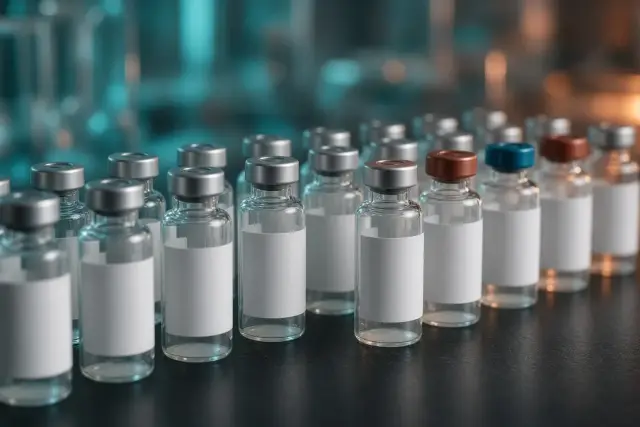
Dozens of online shops sell research peptides, and many look like different companies selling the same products. We compared 15 shops' menus, prices and 98 of their lab reports. The pattern fits a market where many brands buy finished vials from a few manufacturers and sell them under their own labels. So the question to ask isn't "which brand?" but "was the lot I'm buying tested, and does the lab confirm it?"
Read the guide →