 Peps
Peps
What is Lixisenatide?
Lixisenatide is a GLP-1 receptor agonist. ELIXA studied cardiovascular safety in people with type 2 diabetes who had recently experienced an acute coronary event.
Biological role or research focus
Diabetes and cardiovascular outcomes.
The finding supports cardiovascular safety within the trial’s prespecified framework. It does not establish cardiovascular benefit. Heart-failure hospitalization and mortality were not significantly different. Sanofi funded the trial.
Role reference: Lixisenatide in Patients with Type 2 Diabetes and Acute Coronary Syndrome. · 2015 ↗
- Class / identity
- GLP-1 receptor agonist
- Research focus
- Diabetes and cardiovascular outcomes
- Featured evidence
- Human randomized trial
- Source check
- October 4, 2026
Source: Lixisenatide in Patients with Type 2 Diabetes and Acute Coronary Syndrome. · 2015 ↗
Molecular structure
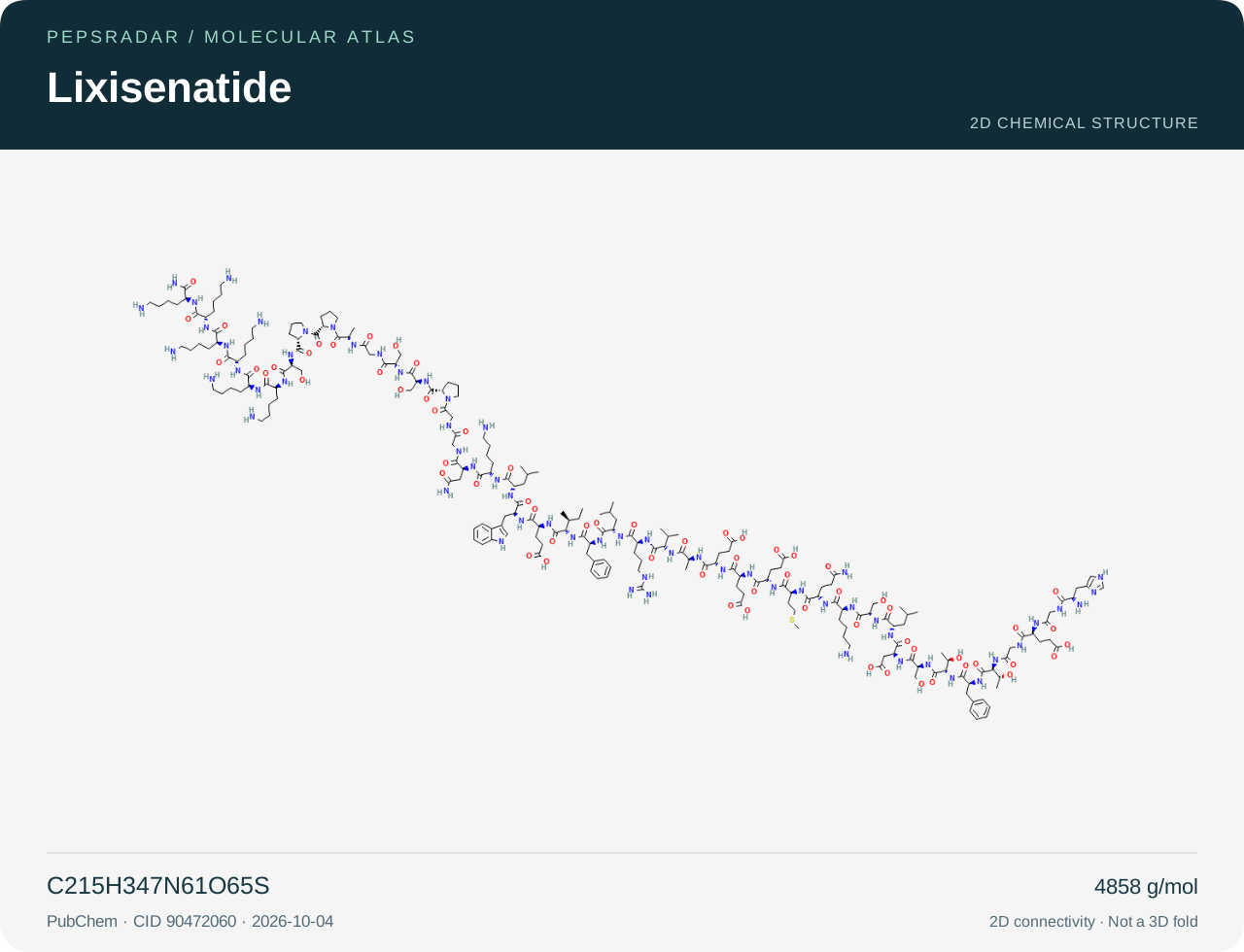
How Lixisenatide works
GLP-1 receptor agonism is an incretin approach to glucose regulation. A glucose-lowering mechanism does not by itself establish fewer heart attacks or longer survival; those outcomes require clinical trials.
Source: Lixisenatide in Patients with Type 2 Diabetes and Acute Coronary Syndrome. · 2015 ↗
Clinical context & research status
This profile focuses on cardiovascular outcomes in a defined diabetes population. Product indications and precautions depend on the current local prescribing information.
Source: Lixisenatide in Patients with Type 2 Diabetes and Acute Coronary Syndrome. · 2015 ↗
What does the evidence show?
Selected published evidence, with the population, findings, and limits kept together. These original summaries draw on publication abstracts; they are not a systematic review.
Human randomized trial · 2015
ELIXA
Did cardiovascular events differ after a recent coronary event?
- Population / model
- 6,068 people with type 2 diabetes and an acute coronary event in the preceding 180 days.
- Study design
- Randomized placebo-controlled cardiovascular-outcomes study; median follow-up 25 months.
- Main finding
- The primary cardiovascular composite occurred in 13.4% with lixisenatide and 13.2% with placebo: hazard ratio 1.02 (95% CI 0.89–1.17). Noninferiority was established; superiority was not.
- Limits & context
- The finding supports cardiovascular safety within the trial’s prespecified framework. It does not establish cardiovascular benefit. Heart-failure hospitalization and mortality were not significantly different. Sanofi funded the trial.
Source: Lixisenatide in Patients with Type 2 Diabetes and Acute Coronary Syndrome. · 2015 ↗
Human phase 2 randomized trial · 2024
LIXIPARK · early Parkinson disease
Did motor-disability progression differ in early Parkinson disease?
- Population / model
- 156 people diagnosed less than three years earlier, receiving stable symptomatic medication and without motor complications.
- Study design
- Double-blind placebo-controlled trial over 12 months, followed by a two-month washout. The primary motor-score endpoint was assessed in the on-medication state.
- Main finding
- MDS-UPDRS part III changed by −0.04 points with lixisenatide versus +3.04 with placebo; difference 3.08 points (95% CI 0.86–5.30). Nausea occurred in 46% and vomiting in 13% of lixisenatide recipients.
- How to read it
- This phase 2 motor-score result is a distinct question from ELIXA cardiovascular safety in diabetes.
- Limits & context
- Other secondary outcomes did not differ substantially. Larger and longer trials are needed; this is not proof of cure, prevention, or an established Parkinson indication.
Read the original paper for methods, adverse events, funding, and conflicts of interest. Publisher access may require a subscription.
Search additional PubMed records ↗New editorial updates
New source discoveries
Links appear automatically. Unreviewed discoveries are not verified medical findings.
Safety & precautions
What the featured evidence can tell us
Read the product label for complete gastrointestinal, glucose-related, kidney, and interaction precautions. The ELIXA comparison cannot establish that all GLP-1 products share the same cardiovascular effect.
Source: Lixisenatide in Patients with Type 2 Diabetes and Acute Coronary Syndrome. · 2015 ↗
Identity, route, and evidence limits
The finding supports cardiovascular safety within the trial’s prespecified framework. It does not establish cardiovascular benefit. Heart-failure hospitalization and mortality were not significantly different. Sanofi funded the trial.
Source: Lixisenatide in Patients with Type 2 Diabetes and Acute Coronary Syndrome. · 2015 ↗
This is not a complete list of contraindications, interactions, or adverse effects. Medicine labels apply to specific products and indications; research-use listings are not interchangeable with approved medicines.
What are people discussing?
No editorial transcript note has been reviewed for this profile yet. Below are the matching video records available for exploration; title and caption matches are not verified claims.
Watch the source discussions
0 matching video records · 0 with captions indexed.
Across the full library, 30 caption files are indexed from 20,199 inventoried videos. Most transcripts remain unreviewed. Select a thumbnail or timestamp to watch inside PepsRadar. Thumbnail images load from YouTube.
No matching video has been identified in the current snapshot.
Sources & supplier listings
Listings are grouped by the vendor’s stated identity. Blends and modified derivatives are labeled separately. Inclusion is not a quality assessment or an endorsement.
We have not added a supplier for this profile. Missing products and coded listings are not filled with guesses.
Catalog checked 2026-10-04. Seller listings retain their stated intended use. Shops covered: BioLongevity Labs, BioLongevity Supplements, American Peptides, PSPeptides. This is not a market-wide comparison. Affiliate participation does not determine evidence or editorial coverage.
Questions worth asking
- Is noninferiority the same as a cardiovascular benefit?
- What population, comparator, and route were actually studied?
- The finding supports cardiovascular safety within the trial’s prespecified framework. It does not establish cardiovascular benefit. Heart-failure hospitalization and mortality were not significantly different. Sanofi funded the trial.
- What adverse effects, uncertainty, and conflicts of interest does the original source report?
Frequently asked questions
Is noninferiority the same as a cardiovascular benefit?
No. Noninferiority tests whether an unacceptable increase can be excluded within a specified margin. It is not proof that events were reduced.
Source: Lixisenatide in Patients with Type 2 Diabetes and Acute Coronary Syndrome. · 2015 ↗
Does this page establish a supplier’s product quality?
No. A publication describes its own tested material. It does not verify a supplier listing, batch identity, purity, or clinical suitability.
Source: Lixisenatide in Patients with Type 2 Diabetes and Acute Coronary Syndrome. · 2015 ↗
References & editorial record
Source notes checked 2026-10-04. Original PepsRadar summaries. Not reviewed by a medical professional. Topic grouping is editorial navigation, not a treatment recommendation. Video notes specify which excerpts were reviewed; no full transcripts are published.