 Peps
Peps
What is Bivalirudin?
Bivalirudin is a direct thrombin-inhibitor peptide used in procedural anticoagulation. The featured analysis examined patients with ST-elevation myocardial infarction undergoing coronary intervention.
Biological role or research focus
Procedural anticoagulation.
The composite comparison was not statistically significant. Access route, accompanying antiplatelet treatment, and subgroup context limit generalization to every procedure.
Role reference: Bivalirudin Versus Heparin Monotherapy in ST-Segment-Elevation Myocardial Infarction. · 2021 ↗
- Class / identity
- Direct thrombin-inhibitor peptide
- Research focus
- Procedural anticoagulation
- Featured evidence
- Prespecified subgroup of a randomized trial
- Source check
- October 4, 2026
Source: Bivalirudin Versus Heparin Monotherapy in ST-Segment-Elevation Myocardial Infarction. · 2021 ↗
Molecular structure
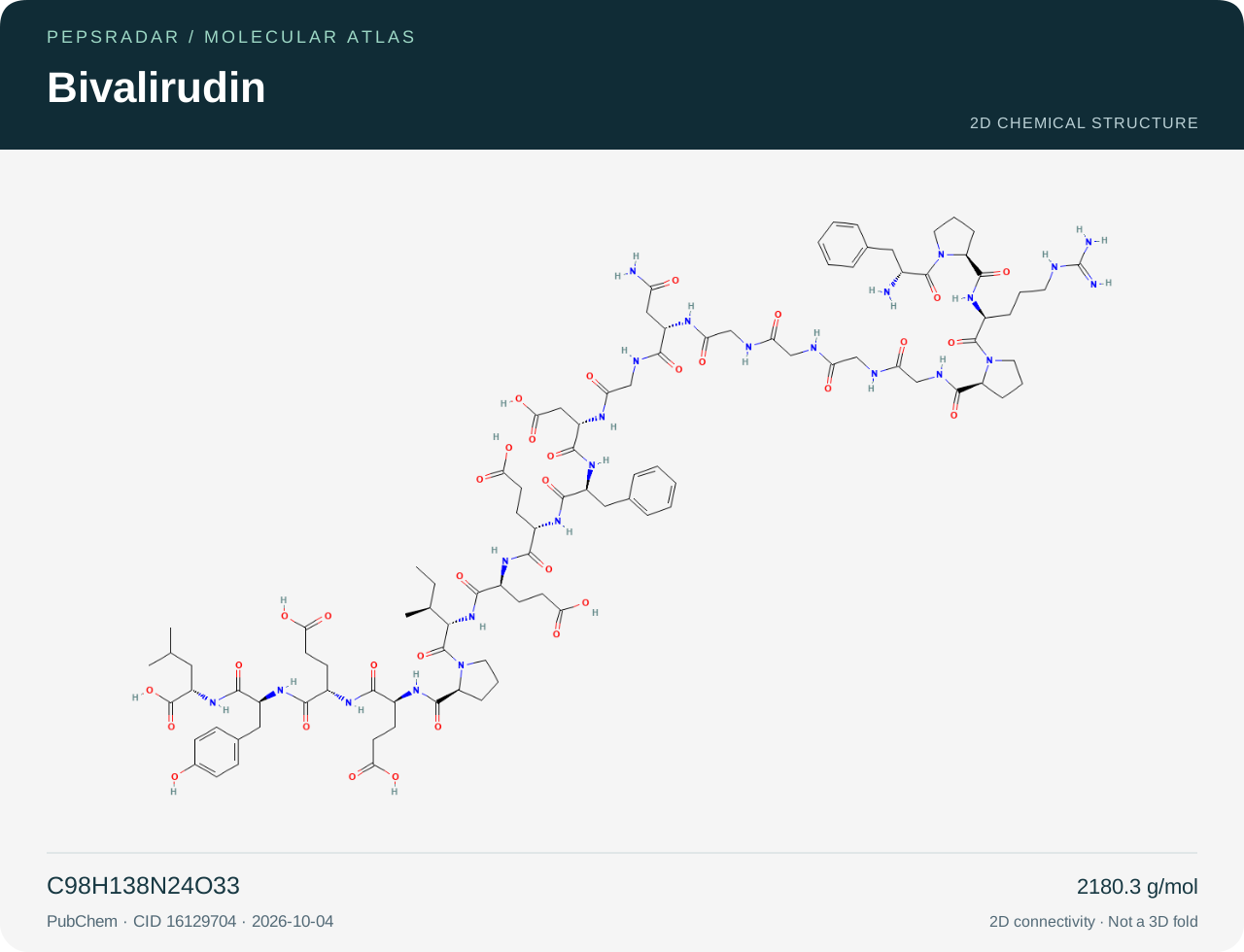
How Bivalirudin works
Thrombin inhibition reduces clot formation. That pharmacological effect creates both a therapeutic purpose and a bleeding risk; it is not a general cardiovascular-health supplement.
Source: Bivalirudin Versus Heparin Monotherapy in ST-Segment-Elevation Myocardial Infarction. · 2021 ↗
Medicine status & clinical context
Bivalirudin is a prescription anticoagulant for percutaneous coronary intervention, including specified patients with heparin-induced thrombocytopenia. An approved procedural use is distinct from whether a particular trial proves superiority over heparin.
The selected analysis concerns anticoagulation during coronary intervention in a modern treatment setting. Product-specific indications and monitoring require current clinical references.
Source: DailyMed · Bivalirudin prescribing information · May 2025 ↗
Source: Bivalirudin Versus Heparin Monotherapy in ST-Segment-Elevation Myocardial Infarction. · 2021 ↗
What does the evidence show?
Selected published evidence, with the population, findings, and limits kept together. These original summaries draw on publication abstracts; they are not a systematic review.
Prespecified subgroup of a randomized trial · 2021
VALIDATE-SWEDEHEART STEMI subgroup
Did death, myocardial infarction, or major bleeding differ versus heparin?
- Population / model
- 3,005 patients with ST-elevation myocardial infarction in a prespecified VALIDATE-SWEDEHEART subgroup.
- Study design
- Randomized comparison of bivalirudin with heparin; approximately 90% radial access; contemporary antiplatelet treatment; 180-day outcomes.
- Main finding
- The composite of death, myocardial infarction, or major bleeding occurred in 12.5% versus 13.0%: hazard ratio 0.95 (95% CI 0.78–1.17).
- Limits & context
- The composite comparison was not statistically significant. Access route, accompanying antiplatelet treatment, and subgroup context limit generalization to every procedure.
Source: Bivalirudin Versus Heparin Monotherapy in ST-Segment-Elevation Myocardial Infarction. · 2021 ↗
Read the original paper for methods, adverse events, funding, and conflicts of interest. Publisher access may require a subscription.
Further reading · 4 additional publication links
Exact-name PubMed search checked 2026-10-04. These records have not been appraised. A name match can include related compounds, combinations, or other formulations; it does not establish safety or benefit.
Bivalirudin. ↗
· 2024 Jan · Study Guide
Bivalirudin. ↗
Thrombosis and haemostasis · 2008 May · Journal Article, Research Support, Non-U.S. Gov't, Review
Prospective Randomized Pilot Study Comparing Bivalirudin Versus Heparin in Neonatal and Pediatric Extracorporeal Membrane Oxygenation. ↗
Pediatric critical care medicine : a journal of the Society of Critical Care Medicine and the World Federation of Pediatric Intensive and Critical Care Societies · 2025 Jan 1 · Journal Article, Randomized Controlled Trial, Comparative Study
Read available full text ↗
Bivalirudin in Extracorporeal Membrane Oxygenation. ↗
Journal of cardiovascular pharmacology · 2024 Dec 1 · Journal Article, Review
New editorial updates
New source discoveries
Links appear automatically. Unreviewed discoveries are not verified medical findings.
Safety & precautions
What the featured evidence can tell us
Bleeding is a central consideration for anticoagulants. This subgroup analysis does not provide a personal treatment regimen or prove that bivalirudin is superior in every interventional setting.
Source: Bivalirudin Versus Heparin Monotherapy in ST-Segment-Elevation Myocardial Infarction. · 2021 ↗
Identity, route, and evidence limits
The composite comparison was not statistically significant. Access route, accompanying antiplatelet treatment, and subgroup context limit generalization to every procedure.
Source: Bivalirudin Versus Heparin Monotherapy in ST-Segment-Elevation Myocardial Infarction. · 2021 ↗
Official product context · checked October 4, 2026
Major active bleeding and hypersensitivity are contraindications in the linked label. Bleeding, acute stent thrombosis in certain procedural settings, and renal-function considerations require clinical oversight.
Source: DailyMed · Bivalirudin prescribing information · May 2025 ↗
This is not a complete list of contraindications, interactions, or adverse effects. Medicine labels apply to specific products and indications; research-use listings are not interchangeable with approved medicines.
What are people discussing?
No editorial transcript note has been reviewed for this profile yet. Below are the matching video records available for exploration; title and caption matches are not verified claims.
Watch the source discussions
0 matching video records · 0 with captions indexed.
Across the full library, 30 caption files are indexed from 20,199 inventoried videos. Most transcripts remain unreviewed. Select a thumbnail or timestamp to watch inside PepsRadar. Thumbnail images load from YouTube.
No matching video has been identified in the current snapshot.
Sources & supplier listings
Listings are grouped by the vendor’s stated identity. Blends and modified derivatives are labeled separately. Inclusion is not a quality assessment or an endorsement.
We have not added a supplier for this profile. Missing products and coded listings are not filled with guesses.
Catalog checked 2026-10-04. Seller listings retain their stated intended use. Shops covered: BioLongevity Labs, BioLongevity Supplements, American Peptides, PSPeptides. This is not a market-wide comparison. Affiliate participation does not determine evidence or editorial coverage.
Questions worth asking
- Did this analysis show fewer deaths, infarctions, or major bleeds overall?
- What population, comparator, and route were actually studied?
- The composite comparison was not statistically significant. Access route, accompanying antiplatelet treatment, and subgroup context limit generalization to every procedure.
- What adverse effects, uncertainty, and conflicts of interest does the original source report?
Frequently asked questions
Did this analysis show fewer deaths, infarctions, or major bleeds overall?
The combined endpoint did not significantly differ. A nonsignificant result does not establish identical outcomes, and individual components require separate reading.
Source: Bivalirudin Versus Heparin Monotherapy in ST-Segment-Elevation Myocardial Infarction. · 2021 ↗
Does this page establish a supplier’s product quality?
No. A publication describes its own tested material. It does not verify a supplier listing, batch identity, purity, or clinical suitability.
Source: Bivalirudin Versus Heparin Monotherapy in ST-Segment-Elevation Myocardial Infarction. · 2021 ↗
Does the official medicine reference cover every use discussed online?
No. The reference covers defined products and clinical settings. Research outside those uses needs separate evidence and does not extend the medicine’s authorization.
Source: DailyMed · Bivalirudin prescribing information · May 2025 ↗
References & editorial record
Source notes checked 2026-10-04. Original PepsRadar summaries. Not reviewed by a medical professional. Topic grouping is editorial navigation, not a treatment recommendation. Video notes specify which excerpts were reviewed; no full transcripts are published.