 Peps

The short answer
Ipamorelin is not an ingredient in any FDA-approved drug. In 2023 the FDA placed it in its “category 2” of bulk substances that may present significant safety risks in compounding. The nomination for regular pharmacy compounding was later withdrawn, and as of April 2026 the FDA lists it as nominated but withdrawn. It is not on the list of substances pharmacies may use, and it remains in category 2 for outsourcing facilities.
In October 2026 HHS announced it would not take enforcement action against pharmacies compounding six peptides while the FDA writes formal rules. Ipamorelin is not one of the six (they are BPC-157, epitalon, KPV, MOTS-c, Semax and TB-500).
Online it is mostly sold as a “research use only” product. In August 2026 the FDA sent warning letters to research-peptide sellers that named ipamorelin products among unapproved new drugs. This is a summary of public regulatory documents, not legal advice, and rules differ by country and state.
Source: FDA: bulk drug substances that may present significant safety risks ↗
Source: HHS peptide compounding policy, Federal Register, October 2026 ↗
Source: FDA warning letter to a research-peptide seller, August 2026 ↗
Banned in sport
The World Anti-Doping Agency’s 2026 Prohibited List names ipamorelin explicitly, under growth hormone releasing factors. Athletes in tested sports can face sanctions for using it, in or out of competition.
Source: WADA 2026 Prohibited List ↗
What ipamorelin is
Ipamorelin is a small synthetic peptide developed in the 1990s to make the pituitary gland release growth hormone. Its reputation as “selective” comes from early animal work: in pigs, it released growth hormone with a smaller rise in the stress hormones ACTH and cortisol than two older peptides, GHRP-2 and GHRP-6. That is a laboratory finding, not evidence of safety or benefit in people.
Source: Ipamorelin, the first selective growth hormone secretagogue. ↗
What human studies exist
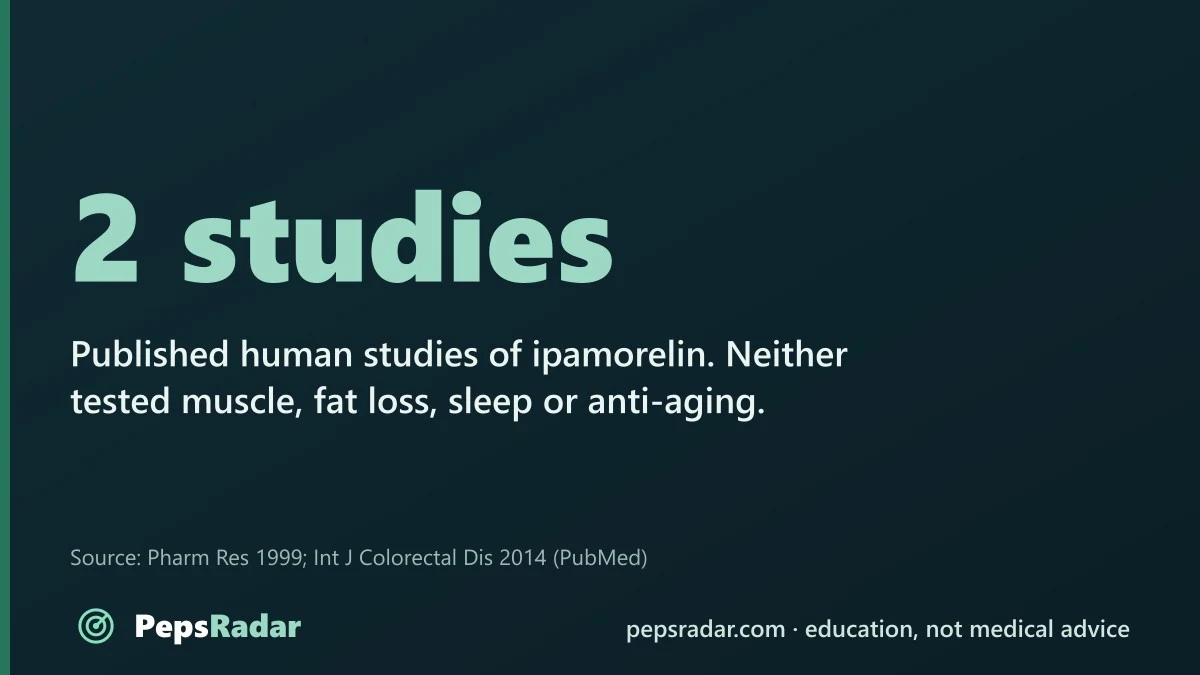
Only two small human studies are published. In 1999, healthy men received a single 15-minute intravenous infusion at five levels, eight men per level. Ipamorelin raised growth hormone in a dose-dependent way and cleared from the blood quickly, with a half-life of about two hours.
In 2014, a randomized trial gave ipamorelin or placebo to 114 patients after bowel surgery to see whether it sped up recovery of gut function. Patients on ipamorelin tolerated a meal after a median 25.3 hours versus 32.6 hours on placebo, a difference that was not statistically significant, and none of the efficacy measures differed significantly. Side effects were common in both groups (87.5% versus 94.8%), as expected after surgery.
No published trials have tested ipamorelin for muscle, fat loss, sleep, recovery or anti-aging, the uses it is marketed for online.
Source: Gobburu et al., Pharm Res 1999 ↗
Side effects and safety concerns
Because there are no long-term or everyday-use trials, the side effects of ipamorelin as it is commonly used are not established. The FDA’s concerns are about the product itself: injectable peptides like this can trigger immune reactions if they clump or contain impurities, and ipamorelin’s unnatural amino acids make it harder to confirm what is in a vial. The FDA also notes a published report of serious adverse events, including a death, when ipamorelin was given intravenously to improve gut motility, and says it lacks safety information for other injectable routes.
In October 2026 a coroner in Victoria, Australia found that the death of actor Richard Norton in March 2025 was triggered by injecting compounded CJC-1295 and ipamorelin prescribed by a doctor. He had told a clinic nurse he was taking double the prescribed amount. The coroner recommended that Australia’s drug regulator review the safety of peptides such as these. One case cannot show how common such harm is, but it is the kind of event the FDA’s warnings describe.
Source: FDA: bulk drug substances that may present significant safety risks ↗
What to take away
Interest in ipamorelin runs far ahead of the evidence: two small human studies, neither of which tested the uses it is sold for, and a regulatory record of safety and quality warnings. Research-market vials are not regulated drugs, so their contents and purity depend on the seller; a lab certificate is only useful if the testing lab confirms it issued it.
Anyone considering it should talk with a clinician who knows their health history. PepsRadar gives no dosing, sourcing or usage advice.
Source: FDA: bulk drug substances that may present significant safety risks ↗
Continue with the original research
Study examples are based on selected publication abstracts and the explicitly described source documents. This is not a systematic review or an individualized treatment guide. Editorial scope and methods.