 Peps

The short answer
In the clinical trials, people who stopped semaglutide regained most of the weight they had lost within about a year, and most heart and metabolic measures, such as blood pressure and blood sugar, drifted back toward where they started. The same pattern shows up with tirzepatide.
That doesn’t mean the medicine stopped working. These drugs reduce appetite while they are taken, and appetite tends to return when they stop. The STEP 1 extension authors concluded that their findings confirm obesity is a chronic condition and suggest ongoing treatment is needed to keep the improvements.
Source: STEP 1 extension, Wilding et al., Diabetes Obes Metab 2022 ↗
STEP 1 extension: one year off treatment
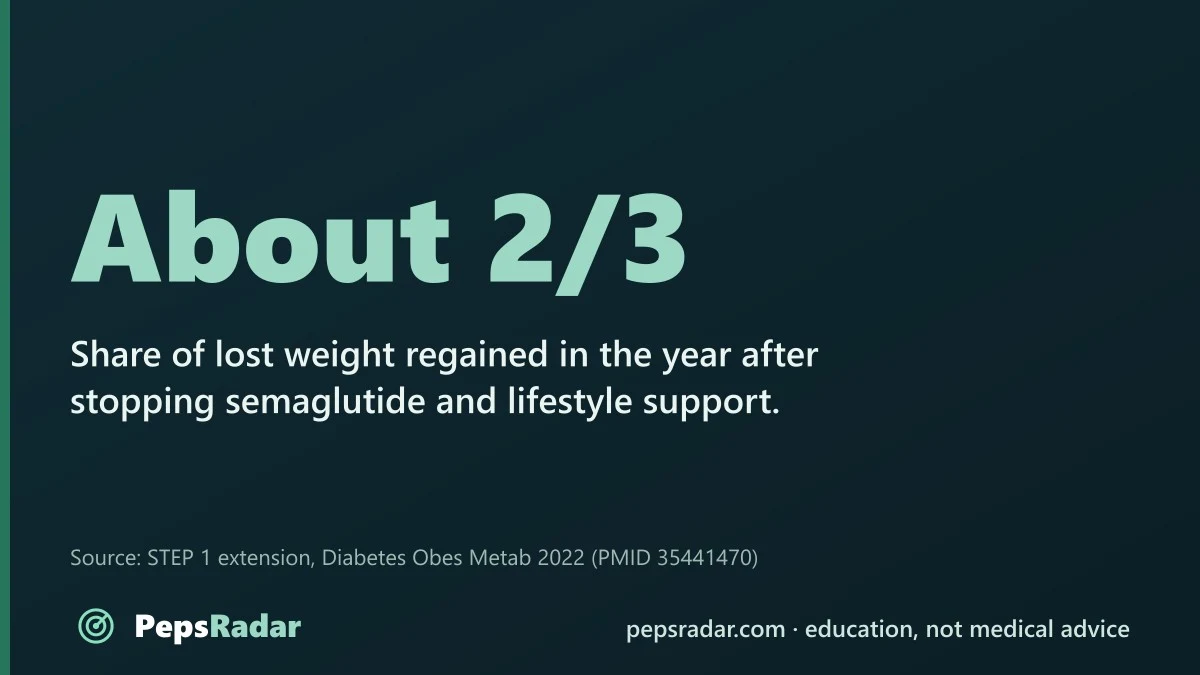
After the main STEP 1 trial, 327 participants were followed for a year with no medicine and no lifestyle program. Over the 68 weeks of treatment they had lost 17.3% of their body weight on semaglutide versus 2.0% on placebo.
A year after stopping, the semaglutide group had regained 11.6 percentage points, leaving them 5.6% below their starting weight. In other words, they regained about two-thirds of what they had lost, though they still weighed less than when they began. Most heart and metabolic measures, such as blood pressure and blood sugar, moved back toward their starting values.
One caution: the lifestyle support ended at the same time as the medicine, and this was a subset of the original trial, so it shows what happens when everything stops at once.
Source: STEP 1 extension, Wilding et al., Diabetes Obes Metab 2022 ↗
STEP 4: switching to placebo partway through
STEP 4 tested stopping directly. 803 adults took semaglutide for 20 weeks and lost an average of 10.6%. They were then randomly assigned either to keep taking it or to switch, without knowing, to a placebo for another 48 weeks.
Those who continued lost a further 7.9% of their weight. Those switched to placebo gained 6.9% back, a 14.8-point difference. Waist size and blood pressure also favored continuing. Stomach and gut side effects were more common on semaglutide (49.1% versus 26.1%), but few people in either group stopped because of side effects (2.4% versus 2.2%).
Tirzepatide shows the same pattern
SURMOUNT-4 ran the same kind of test with tirzepatide (Zepbound). After 36 weeks of treatment and an average 20.9% weight loss, 670 adults were randomly assigned to continue or switch to placebo for a year.
The placebo group regained 14.0% of their body weight, while the tirzepatide group lost another 5.5%. At the end, 89.5% of those who continued had kept at least 80% of their earlier weight loss, versus 16.6% of those switched to placebo.
What may help keep weight off
Exercise is the best-studied option. In a Danish trial, adults who had lost weight on a low-calorie diet were assigned to supervised exercise, liraglutide (an older GLP-1 medicine), both, or placebo for a year, and then followed for a year with no treatment. Those who had done both kept off about 5 kg more than those who had taken liraglutide alone, and people who had exercised were more likely to keep off at least 10% of their weight.
That trial was small (109 people in the follow-up) and used liraglutide rather than semaglutide, so it is a signal, not proof. Whether to continue, step down or stop a GLP-1 medicine, and how to plan for it, is a decision to make with a prescriber. PepsRadar gives no dosing or treatment advice.
Continue with the original research
Study examples are based on selected publication abstracts and the explicitly described source documents. This is not a systematic review or an individualized treatment guide. Editorial scope and methods.