 Peps

Two direct trials, both run by one drugmaker
Semaglutide (Ozempic, Wegovy) activates the GLP-1 hormone receptor. Tirzepatide (Mounjaro, Zepbound) activates both the GLP-1 and the GIP receptors. Most comparisons online line up results from separate trials, which enrolled different people. Only two randomized trials have put the two drugs side by side: SURMOUNT-5 in people with obesity, and SURPASS-2 in people with type 2 diabetes.
Both trials were funded by Eli Lilly, which makes tirzepatide, and both were open-label, meaning participants and doctors knew which drug was given. Neither fact makes the results wrong, but both are worth knowing.
Source: SURMOUNT-5, Aronne et al., N Engl J Med 2025 ↗
Source: Tirzepatide versus Semaglutide Once Weekly in Patients with Type 2 Diabetes. ↗
SURMOUNT-5: weight loss in obesity
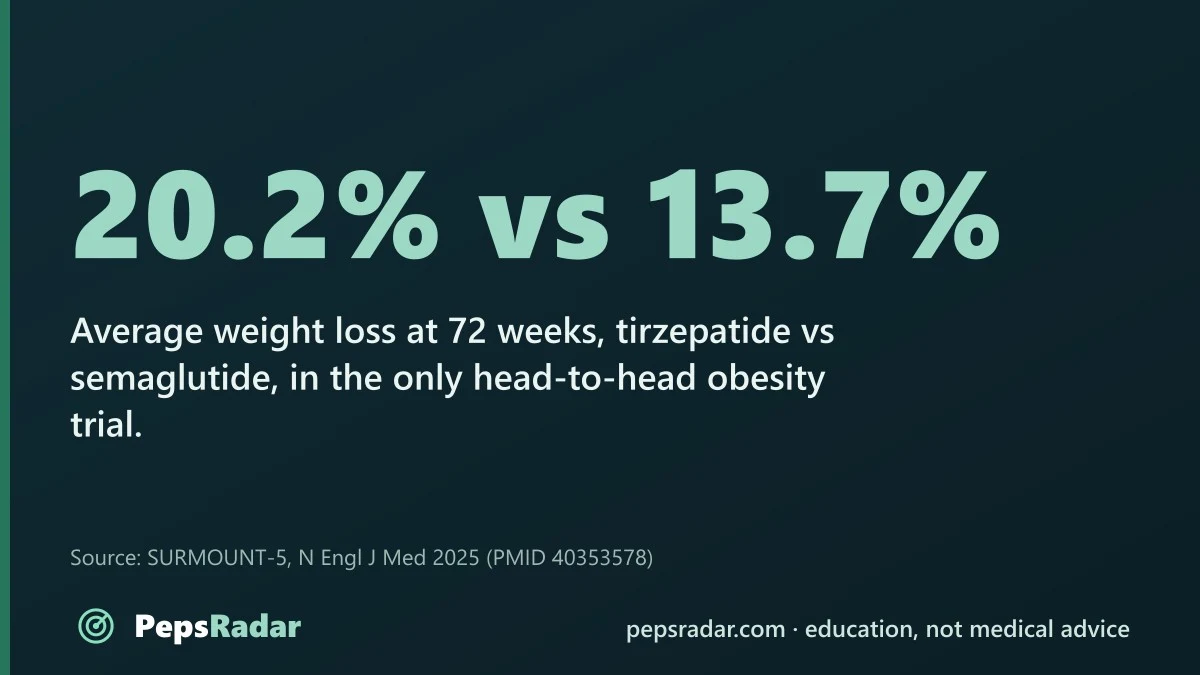
SURMOUNT-5 randomly assigned 751 adults with obesity but without diabetes to tirzepatide or semaglutide for 72 weeks, each at the highest dose the person could tolerate. Weight fell an average of 20.2% with tirzepatide and 13.7% with semaglutide. Waist size fell 18.4 cm versus 13.0 cm, and more people on tirzepatide reached every weight-loss milestone the trial tracked, from 10% to 25%.
The most common side effects on both drugs were stomach and gut problems, mostly mild to moderate and mainly while the dose was being increased.
SURPASS-2: blood sugar in type 2 diabetes
SURPASS-2 compared three tirzepatide groups with semaglutide in 1,879 people with type 2 diabetes over 40 weeks. HbA1c, the main measure of long-term blood sugar, fell 2.01 to 2.30 points with tirzepatide versus 1.86 with semaglutide, and tirzepatide groups lost 1.9 to 5.5 kg more weight.
The semaglutide group received its diabetes regimen, which is lower than the semaglutide regimen approved for weight loss, so the gap may overstate the difference at today’s weight-loss regimens. Side effect rates were similar: nausea in 17 to 22% on tirzepatide versus 18% on semaglutide, diarrhea 13 to 16% versus 12%, and vomiting 6 to 10% versus 8%.
Source: Tirzepatide versus Semaglutide Once Weekly in Patients with Type 2 Diabetes. ↗
Heart outcomes: different evidence for each
Semaglutide has a placebo-controlled heart trial in people without diabetes. In SELECT, adults with overweight or obesity and existing heart disease had a heart attack, stroke or cardiovascular death in 6.5% of cases on semaglutide versus 8.0% on placebo, a 20% lower relative risk.
Tirzepatide’s heart trial, SURPASS-CVOT, compared it with dulaglutide, an older GLP-1 drug already shown to reduce heart events, in 13,299 people with type 2 diabetes and heart disease. Events occurred in 12.2% versus 13.1%. That showed tirzepatide was at least as good as dulaglutide, but the difference was not large enough to prove it better. No trial has compared semaglutide and tirzepatide directly on heart attacks or strokes.
Source: Semaglutide and Cardiovascular Outcomes in Obesity without Diabetes. ↗
What the comparison does and doesn’t tell you
In the only direct obesity trial, tirzepatide produced more weight loss, about 6.5 percentage points more on average. Semaglutide has the longer track record and a placebo-controlled heart result in people without diabetes. Side effects are similar in kind, mostly stomach and gut problems early on.
An average difference does not predict how one person will respond. Which medicine fits, if either, depends on someone’s health conditions, other medicines, tolerability and insurance coverage, and is a decision for a prescriber. Both are prescription medicines, and nothing sold as a research chemical is a substitute for either. PepsRadar gives no dosing or treatment advice.
Source: SURMOUNT-5, Aronne et al., N Engl J Med 2025 ↗
Source: Semaglutide and Cardiovascular Outcomes in Obesity without Diabetes. ↗
Continue with the original research
Study examples are based on selected publication abstracts and the explicitly described source documents. This is not a systematic review or an individualized treatment guide. Editorial scope and methods.