 Peps

How many people respond in the trials
In STEP 1, 1,961 adults with obesity or overweight but without diabetes were randomly assigned to weekly semaglutide at the weight-loss dose or placebo for 68 weeks, alongside diet and activity support. Weight fell an average of 14.9% with semaglutide and 2.4% with placebo.
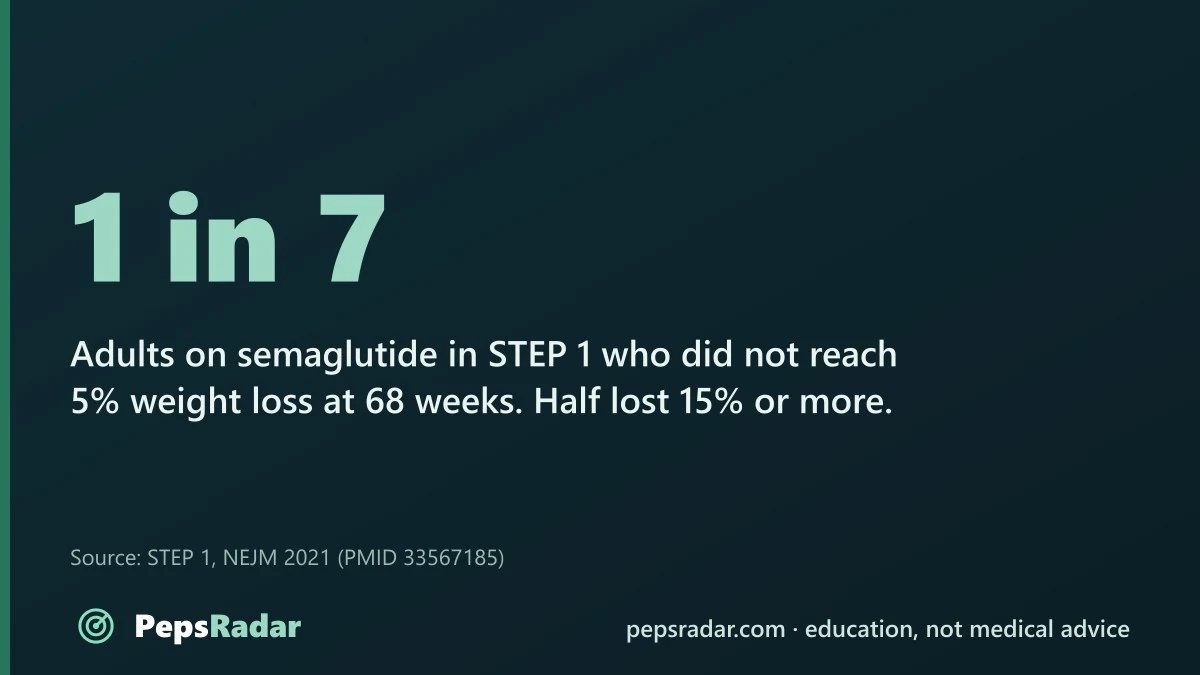
Averages hide a wide spread. On semaglutide, 86.4% lost at least 5% of their weight, 69.1% lost at least 10% and 50.5% lost at least 15%. Put the other way, about 1 in 7 did not reach 5%, while half lost 15% or more. On placebo, 31.5% reached 5%. Side effects also took some people off the drug: 4.5% on semaglutide stopped because of stomach and gut effects, versus 0.8% on placebo.
Source: Once-Weekly Semaglutide in Adults with Overweight or Obesity. ↗
Type 2 diabetes: smaller losses on average
STEP 2 tested the same weight-loss dose in 1,210 adults who had type 2 diabetes as well as overweight or obesity. Over 68 weeks, average weight fell 9.6% with semaglutide versus 3.4% with placebo, and 68.8% on semaglutide lost at least 5%, versus 28.5% on placebo.
That is a real effect, but clearly smaller than in STEP 1. People with type 2 diabetes tend to lose less weight on GLP-1 medicines than people without it, so a smaller result with diabetes is not by itself a sign the drug has failed.
Source: STEP 2, Davies et al., Lancet 2021 ↗
Source: Once-Weekly Semaglutide in Adults with Overweight or Obesity. ↗
Genes may explain part of it
A study published in Nature Metabolism in November 2026 combined exome sequencing with health records from about 352,000 people in the Helix Research Network, including 13,725 adults treated with GLP-1 medicines. People carrying rare, damaging variants in the GLP-1 receptor gene (GLP1R) lost less weight on semaglutide than people without them. On tirzepatide, which also acts on a second receptor called GIP, carriers lost close to the usual amount. Variants in the GIP receptor gene did not change the response.
The findings fit how the drugs work: semaglutide relies on the GLP-1 receptor alone. But this is one observational study, the authors work at a genomics company, and the variants are rare, so they can only explain a small share of people who respond poorly. The study does not establish a test that should guide prescribing.
Source: Levy et al., Nature Metabolism 2026: rare GLP1R variants and semaglutide vs tirzepatide ↗
Does switching to tirzepatide help?
SURMOUNT-5 compared the two drugs head to head in 751 adults with obesity but without diabetes. After 72 weeks, average weight loss was 20.2% with tirzepatide and 13.7% with semaglutide. The trial was funded by Eli Lilly, which makes tirzepatide, and was open-label.
SURMOUNT-5 enrolled people who were new to both drugs, not people who had already responded poorly to semaglutide, so it does not show how much switching helps someone in that position. The gene study above hints that some low responders may do better on tirzepatide, but that has not been tested in a trial.
Source: SURMOUNT-5, Aronne et al., N Engl J Med 2025 ↗
Source: Levy et al., Nature Metabolism 2026: rare GLP1R variants and semaglutide vs tirzepatide ↗
When guidelines say to reassess
In England, NICE guidance on semaglutide for weight management says stopping should be considered if less than 5% of starting weight has been lost after 6 months of treatment. It is a prompt to review, not an automatic stop.
Whether to keep going, change the dose, switch medicine or stop is a decision for the prescriber, who can also check for things that make weight harder to lose, such as other medicines or health conditions.
Source: NICE technology appraisal TA875: semaglutide for managing overweight and obesity ↗
The bottom line
Semaglutide works for most people who take it, but responses vary widely: in STEP 1 about 1 in 7 did not reach 5% weight loss, and people with type 2 diabetes lose less on average. New genetic evidence suggests a small group may respond poorly because of their GLP-1 receptor. If the scale has barely moved after several months, that is worth raising with a prescriber rather than treating as a personal failure.
Source: Once-Weekly Semaglutide in Adults with Overweight or Obesity. ↗
Source: STEP 2, Davies et al., Lancet 2021 ↗
Source: Levy et al., Nature Metabolism 2026: rare GLP1R variants and semaglutide vs tirzepatide ↗
Continue with the original research
Study examples are based on selected publication abstracts and the explicitly described source documents. This is not a systematic review or an individualized treatment guide. Editorial scope and methods.