 Peps

What changed on November 9
The FDA now requires the makers of all GLP-1 receptor agonist medicines to add a warning about a potential increased risk of NAION (non-arteritic anterior ischemic optic neuropathy) to the Warnings and Precautions section of their labels. That covers semaglutide (Ozempic, Wegovy, Rybelsus), tirzepatide, liraglutide, dulaglutide, exenatide and lixisenatide.
NAION happens when blood flow to the front of the optic nerve drops. It typically causes sudden, painless loss of vision in one eye, and the loss can be permanent. Its underlying cause is not fully understood. The FDA lists smoking, diabetes, high blood pressure, sleep apnea, anemia and kidney disease as possible risk factors.
How rare is it?
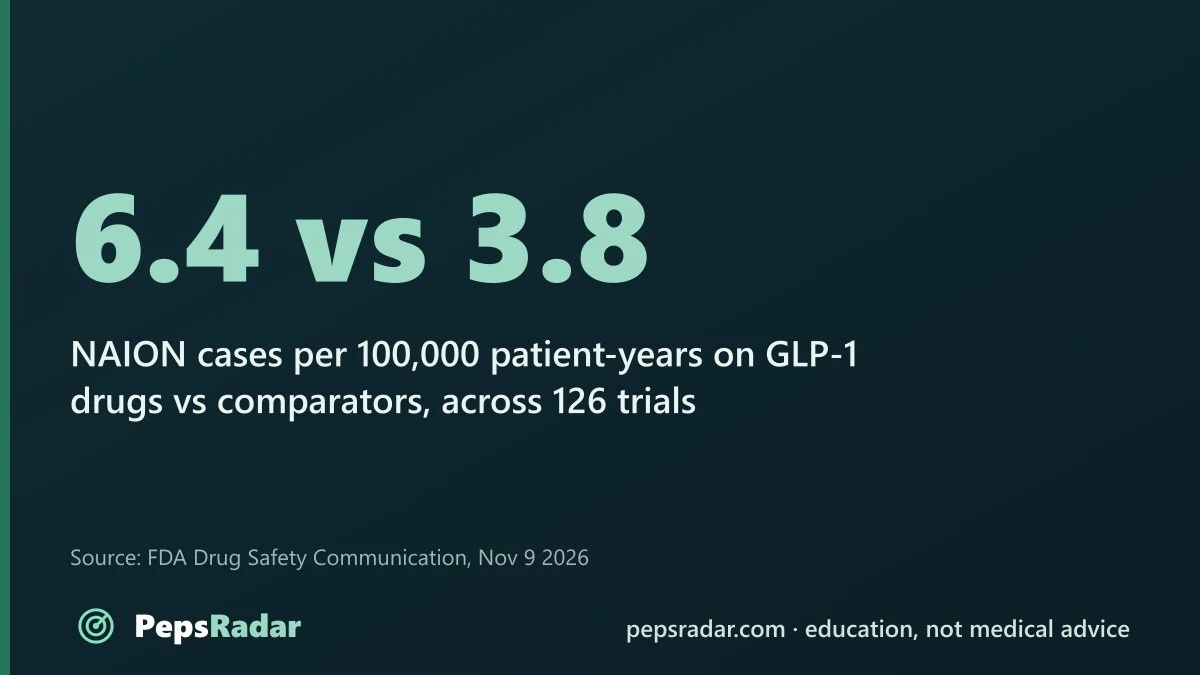
The FDA pooled 126 randomized trials of GLP-1 medicines: 134,253 patients and about 289,000 person-years of follow-up. NAION occurred at 6.4 cases per 100,000 person-years on GLP-1 medicines versus 3.8 on placebo or other diabetes drugs.
Put another way, that is roughly 2.6 extra cases for every 100,000 years of treatment, or about one extra case per 38,000 person-years. The numbers rest on very few events: 15 probable NAION cases in all, 10 on GLP-1 medicines and 5 on placebo. For comparison, the FDA cites a background rate of 2.3 to 10.2 cases per 100,000 people a year in adults over 50, with or without these drugs.
Where the concern came from
A 2024 study from one neuro-ophthalmology practice in Boston started the alarm. Among patients seen there, those prescribed semaglutide had a higher 36-month rate of NAION: 8.9% versus 1.8% in people with type 2 diabetes on other medicines, and 6.7% versus 0.8% in people with overweight or obesity. Those figures come from a specialist eye clinic, where people with vision problems concentrate, so they are far higher than anything seen in the general population, and the FDA noted several limitations of the study.
A larger 2025 study used national health records from Denmark and Norway: about 61,000 people with type 2 diabetes who started semaglutide, compared with people who started a different diabetes drug class (SGLT-2 inhibitors). It observed 32 NAION cases in total. Risk was higher on semaglutide (adjusted hazard ratio 2.81), which worked out to about 1.4 extra cases per 10,000 person-years.
What regulators concluded
In June 2025 the European Medicines Agency’s safety committee concluded that NAION is a very rare side effect of semaglutide, meaning it may affect up to 1 in 10,000 people taking it, and recommended adding it to the product information. It said several large studies suggest roughly a two-fold increase in risk in adults with type 2 diabetes.
The FDA’s November 2026 action goes further in one way, applying the warning to the whole GLP-1 class rather than semaglutide alone. Both agencies describe a rare risk. The evidence is a mix of observational studies, which can show an association but not prove cause, and randomized trial data with very few events, which is why the size of the risk is still uncertain.
Symptoms that need a same-day call
The FDA advises anyone taking a GLP-1 medicine to contact a health care professional right away about sudden vision loss in one eye, blind spots, color distortion or blurry spots. Clinicians are told to refer suspected NAION to an ophthalmologist promptly. Anyone who has had NAION should talk with their health care professional about whether to continue the medicine, because NAION in one eye raises the risk in the other.
Weigh this rare risk against the medicine’s proven benefits, such as fewer heart attacks and strokes in the SELECT trial and fewer serious kidney events in FLOW, both covered with sources on the semaglutide profile. That is a decision to make with a prescriber, not by stopping a prescribed medicine on your own. PepsRadar gives no dosing or treatment advice.
Continue with the original research
Study examples are based on selected publication abstracts and the explicitly described source documents. This is not a systematic review or an individualized treatment guide. Editorial scope and methods.