 Peps

What it is and what the FDA approved
On April 1, 2026 the FDA approved orforglipron, sold by Eli Lilly as Foundayo, for adults with obesity, or with overweight and at least one weight-related health condition, alongside a reduced-calorie diet and more physical activity. It is a tablet taken once a day, and unlike the oral form of semaglutide it does not have to be taken on an empty stomach or with a set amount of water.
Orforglipron works on the same GLP-1 receptor as semaglutide and tirzepatide, but it is not a peptide. It is a small-molecule drug, a compact chemical rather than a chain of amino acids, which is why it survives digestion well enough to work as a pill.
Outside the US, China’s medicine regulator approved orforglipron as a weight-loss pill on November 12, 2026, Reuters reported.
ATTAIN-1: how much weight people lost
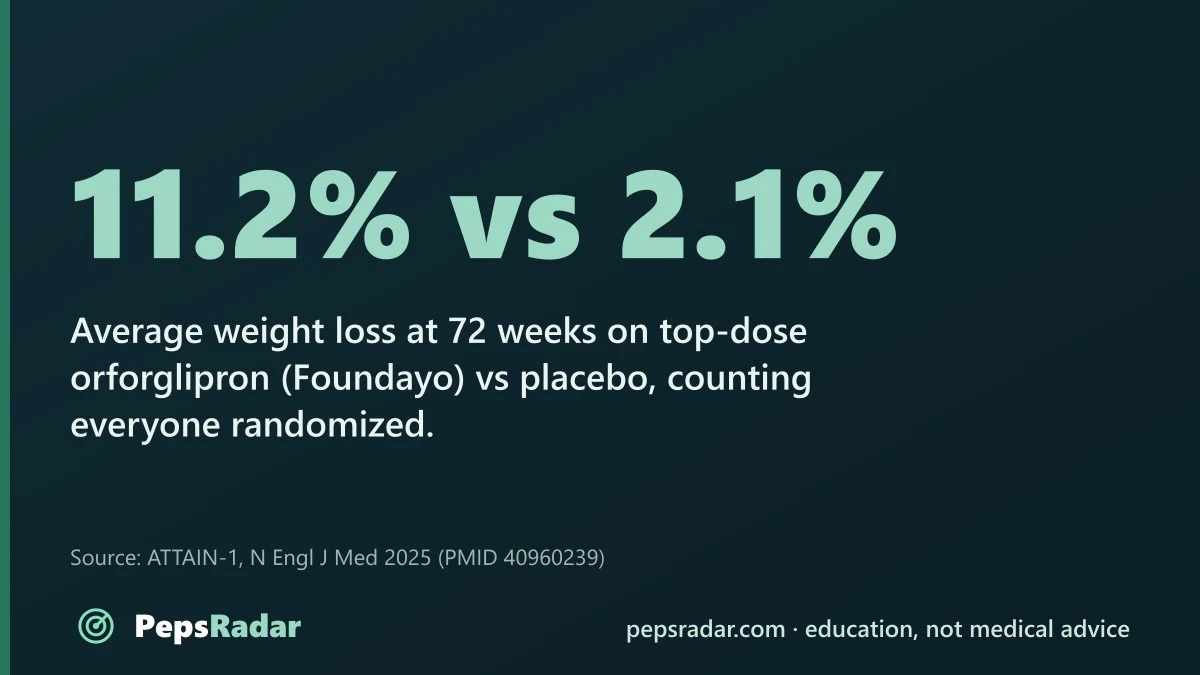
ATTAIN-1 randomly assigned 3,127 adults with obesity but without diabetes to one of three orforglipron doses or placebo for 72 weeks. Counting everyone who was randomized, average weight loss on the highest dose was 11.2% versus 2.1% on placebo. In the analysis of people who kept taking it as directed, it was about 12.4%.
On the highest dose, 54.6% lost at least 10% of their weight, 36.0% lost at least 15% and 18.4% lost at least 20%, compared with 12.9%, 5.9% and 2.8% on placebo. Waist size, blood pressure, triglycerides and non-HDL cholesterol also improved.
Source: Orforglipron, an Oral Small-Molecule GLP-1 Receptor Agonist for Obesity Treatment ↗
In type 2 diabetes, including against the semaglutide pill
In ACHIEVE-1, 559 adults with early type 2 diabetes managed by diet and exercise alone took orforglipron or placebo for 40 weeks. HbA1c, the main long-term blood sugar measure, fell 1.24 to 1.48 points across the orforglipron doses versus 0.41 on placebo.
ACHIEVE-3 compared it directly with oral semaglutide in 1,698 adults with type 2 diabetes for 52 weeks. HbA1c fell 1.71 and 1.91 points on the two orforglipron doses versus 1.23 and 1.47 on the two semaglutide doses, and both orforglipron doses beat both semaglutide doses. The semaglutide doses were the diabetes-pill doses, and the trial was open-label. Stomach and gut side effects were more common with orforglipron (58 to 59% versus 37 to 45%).
Source: ACHIEVE-1, N Engl J Med 2025 ↗
Source: ACHIEVE-3, Lancet 2026 ↗
How it compares with the injections
No trial has compared orforglipron head to head with injectable semaglutide or tirzepatide for weight loss. Separate trials give a rough sense of scale: about 11% on top-dose orforglipron in ATTAIN-1, 14.9% on injectable semaglutide in STEP 1, and 20.2% on tirzepatide in SURMOUNT-5. These trials enrolled different people at different times, so the numbers are not a direct contest.
The trade-off is convenience against size of effect: a daily pill with no injections or food rules, versus weekly injections that produced more weight loss in their own trials.
Source: Orforglipron, an Oral Small-Molecule GLP-1 Receptor Agonist for Obesity Treatment ↗
Source: Once-Weekly Semaglutide in Adults with Overweight or Obesity. ↗
Side effects and warnings
As with other GLP-1 medicines, the most common side effects in ATTAIN-1 were stomach and gut problems, mostly mild to moderate. Side effects led 5.3 to 10.3% of people on orforglipron to stop, versus 2.7% on placebo.
The label carries the same boxed warning as the injectable GLP-1 drugs about thyroid C-cell tumors seen in rodents, with human relevance unknown. Some other medicines change how much orforglipron reaches the blood, and the label covers how prescribers should handle them. In November 2026 the FDA also added a warning about NAION, a rare cause of sudden vision loss in one eye, to every GLP-1 medicine, orforglipron included.
Source: Orforglipron, an Oral Small-Molecule GLP-1 Receptor Agonist for Obesity Treatment ↗
Source: Foundayo prescribing information (DailyMed) ↗
Source: FDA Drug Safety Communication on NAION, November 2026 ↗
The bottom line
Orforglipron gives people a GLP-1 option without injections or strict pill-taking rules, with average weight loss somewhat below the strongest injections in their own trials. Foundayo is a prescription medicine. Products sold online as research-grade “orforglipron” are not Foundayo and are not FDA-approved. Whether it fits, compared with an injection or anything else, is a decision for a prescriber. PepsRadar gives no dosing or treatment advice.
Continue with the original research
Study examples are based on selected publication abstracts and the explicitly described source documents. This is not a systematic review or an individualized treatment guide. Editorial scope and methods.