 Peps

One class, one common complaint
Semaglutide, tirzepatide, retatrutide and orforglipron all act on the GLP-1 receptor. Tirzepatide adds a second hormone target (GIP) and retatrutide a third (glucagon), while orforglipron is a once-daily pill made from a small chemical rather than a peptide. In the main obesity trial for each one, stomach and gut problems were the most common side effects.
Source: Once-Weekly Semaglutide in Adults with Overweight or Obesity. ↗
Source: Tirzepatide Once Weekly for the Treatment of Obesity. ↗
Source: Retatrutide, a Triple Hormone Receptor Agonist, for Treatment of Obesity ↗
Source: Orforglipron, an Oral Small-Molecule GLP-1 Receptor Agonist for Obesity Treatment ↗
Semaglutide in STEP 1
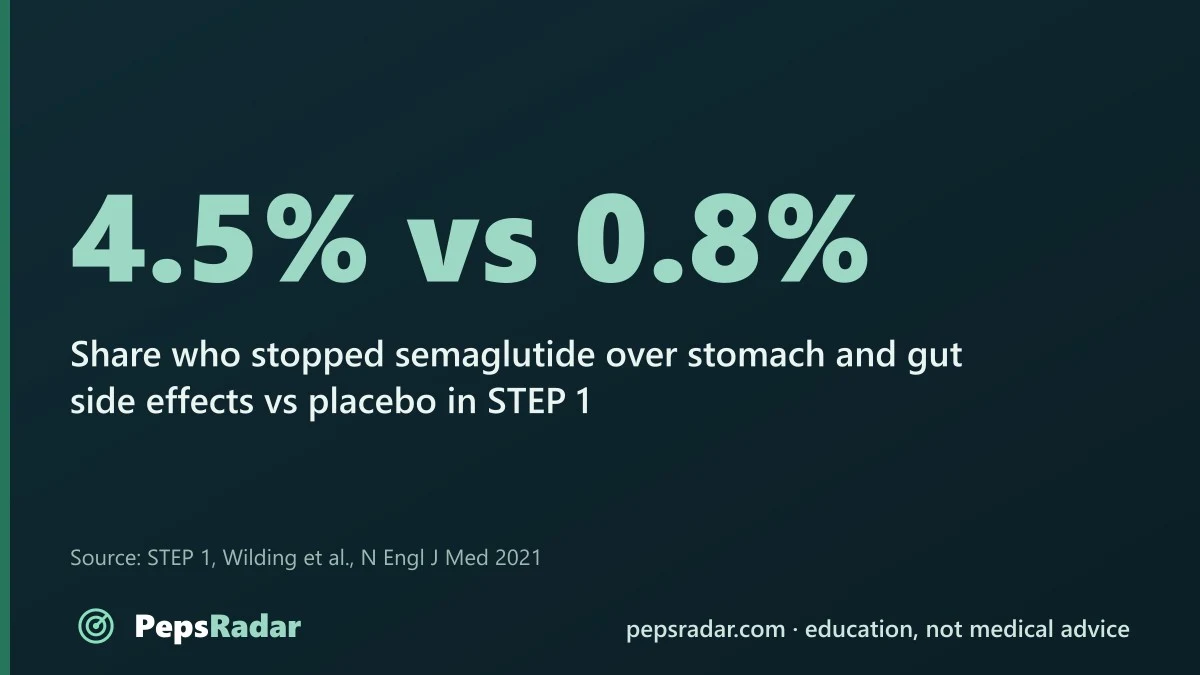
STEP 1 followed 1,961 adults without diabetes for 68 weeks. Nausea and diarrhea were the most common side effects, and they were usually short-lived, mild to moderate and eased with time. Still, 4.5% of people on semaglutide stopped because of stomach and gut effects, compared with 0.8% on placebo.
The STEP 1 summary does not break down individual symptoms, but the Wegovy label does for its pooled adult weight-loss trials of the injection: stomach and gut reactions in 73% versus 47% on placebo, including nausea (44% vs 16%), diarrhea (30% vs 16%) and vomiting (25% vs 6%). Gallstones were reported in 1.6% versus 0.7%, and gallbladder inflammation in 0.6% versus 0.2%.
Source: Once-Weekly Semaglutide in Adults with Overweight or Obesity. ↗
Tirzepatide in SURMOUNT-1
SURMOUNT-1 enrolled 2,539 adults without diabetes for 72 weeks, starting with a 20-week period of gradual dose increases. Stomach and gut effects were the most common, mostly mild to moderate, and clustered in that step-up period. Side effects led 4.3%, 7.1% and 6.2% of people on the three tirzepatide doses to stop, versus 2.6% on placebo.
The Zepbound label pools SURMOUNT-1 with a second trial in adults with type 2 diabetes. On the highest dose, nausea affected 28% (placebo 8%), diarrhea 23% (8%), vomiting 13% (2%) and constipation 11% (5%). Gallstones were reported in 1.1% versus 1%, gallbladder inflammation in 0.7% versus 0.2%, and confirmed acute pancreatitis in 0.2% of both groups. Average heart rate rose by 1 to 3 beats per minute, with no rise on placebo.
Source: Tirzepatide Once Weekly for the Treatment of Obesity. ↗
Retatrutide in TRIUMPH-1
TRIUMPH-1 randomly assigned 2,339 adults with obesity but without diabetes to one of three retatrutide doses or placebo for 80 weeks. Its published summary says only that the most common side effects were gastrointestinal. It gives no rates for individual symptoms, stopping treatment, gallbladder problems, pancreatitis or heart rate, so we have left those out until the full numbers can be checked.
Retatrutide is still investigational and is not FDA-approved, so there is no prescribing label with pooled safety data yet.
Source: Retatrutide, a Triple Hormone Receptor Agonist, for Treatment of Obesity ↗
Orforglipron in ATTAIN-1
ATTAIN-1 tested three doses of the daily orforglipron pill against placebo in 3,127 adults with obesity and without diabetes for 72 weeks. Stomach and gut effects were again the most common and were mostly mild to moderate. Side effects led 5.3% to 10.3% of people on orforglipron to stop, compared with 2.7% on placebo, and the authors described the overall side-effect profile as consistent with other GLP-1 medicines.
Source: Orforglipron, an Oral Small-Molecule GLP-1 Receptor Agonist for Obesity Treatment ↗
Why these numbers are not a fair head-to-head
No trial has compared all four drugs directly. The trials ran for different lengths (68, 72, 80 and 72 weeks), raised doses on different schedules, and tested different numbers of dose levels. They also counted different things: STEP 1 highlights stopping because of stomach and gut effects, while the other three report stopping for any side effect.
Placebo groups matter too. Stomach and gut complaints were common on placebo as well (47% in the Wegovy pool and 30% in the Zepbound pool), so the gap between drug and placebo inside one trial says more than any single percentage set beside another trial's.
Source: Once-Weekly Semaglutide in Adults with Overweight or Obesity. ↗
Source: Tirzepatide Once Weekly for the Treatment of Obesity. ↗
Source: Retatrutide, a Triple Hormone Receptor Agonist, for Treatment of Obesity ↗
Source: Orforglipron, an Oral Small-Molecule GLP-1 Receptor Agonist for Obesity Treatment ↗
Warnings the whole class shares
Approved GLP-1 medicines carry a boxed warning because semaglutide and tirzepatide caused thyroid C-cell tumors in rodents. Whether they do so in people is unknown, and the medicines are not used in people with a personal or family history of medullary thyroid cancer or MEN 2. The labels also warn about acute pancreatitis and gallbladder disease.
In November 2026 the FDA required every GLP-1 medicine to warn about NAION, a rare cause of sudden, painless vision loss in one eye. Across 126 trials there were 6.4 cases per 100,000 person-years on GLP-1 drugs versus 3.8 on comparators, from 15 probable cases in all. Sudden vision changes in one eye call for prompt contact with a health care professional.
PepsRadar gives no dosing or treatment advice. Side effects, and whether a medicine is right for you, should be discussed with a prescriber.
Source: Wegovy prescribing information (DailyMed) ↗
Source: Zepbound prescribing information (DailyMed) ↗
Source: FDA Drug Safety Communication on NAION, November 2026 ↗
Continue with the original research
Study examples are based on selected publication abstracts and the explicitly described source documents. This is not a systematic review or an individualized treatment guide. Editorial scope and methods.