 Peps
What the body scans showed
In a SURMOUNT-1 substudy, 160 adults had DXA body scans at the start and at week 72. On tirzepatide, body weight fell 21.3%, fat mass 33.9% and lean mass 10.9%. About 75% of the weight lost was fat and 25% was lean mass, and the placebo group, which lost far less weight, showed the same split.
For semaglutide, the SURMOUNT-1 authors summarize the STEP 1 DXA substudy as showing a 10.4 kg drop in fat mass and a 6.9 kg drop in lean mass, roughly 60% fat and 40% lean. In the full STEP 1 trial, average body weight fell 14.9% over 68 weeks, compared with 2.4% on placebo. Different trials enrolled different people for different lengths of time, so a straight drug-versus-drug comparison is not possible.
Source: Look et al. · SURMOUNT-1 DXA substudy · 2025 ↗
Source: Once-Weekly Semaglutide in Adults with Overweight or Obesity. ↗
Across many trials, the share varies widely
A 2026 systematic review pooled 35 randomized trials of incretin drugs. On average, muscle-related measures made up 28.3% of the weight lost, and about two thirds of drug arms went past the roughly 25% benchmark the authors set in advance. That was not unique to drugs: nearly half of the diet or placebo arms that produced weight loss also crossed their benchmarks.
A 2024 review found the same spread from another angle. Some studies put lean mass at 40% to 60% of the weight lost, while others put it at about 15% or less.
Lean mass is not the same as muscle
Lean mass, as these studies measure it, includes not only muscle but also organs, bone, fluids and the water held in fat tissue. That means a drop in lean mass does not translate one-for-one into lost muscle.
The 2024 review argued that MRI studies suggest muscle losses are roughly what you would expect for the weight lost, age and health status, and that fat stored inside muscle tends to improve. In SURMOUNT-1, people on tirzepatide reported better physical function even though their lean mass went down.
What happened when people lifted weights
The T-REx trial gave tirzepatide to 120 adults for 40 weeks and randomly assigned half to resistance training three times a week. Adherence to the training was 91%. Weight loss was nearly identical (22.6 kg without training, 22.3 kg with it), and so was fat loss (17.2 kg and 18.0 kg). Lean mass loss was smaller with training: 3.6 kg compared with 4.7 kg.
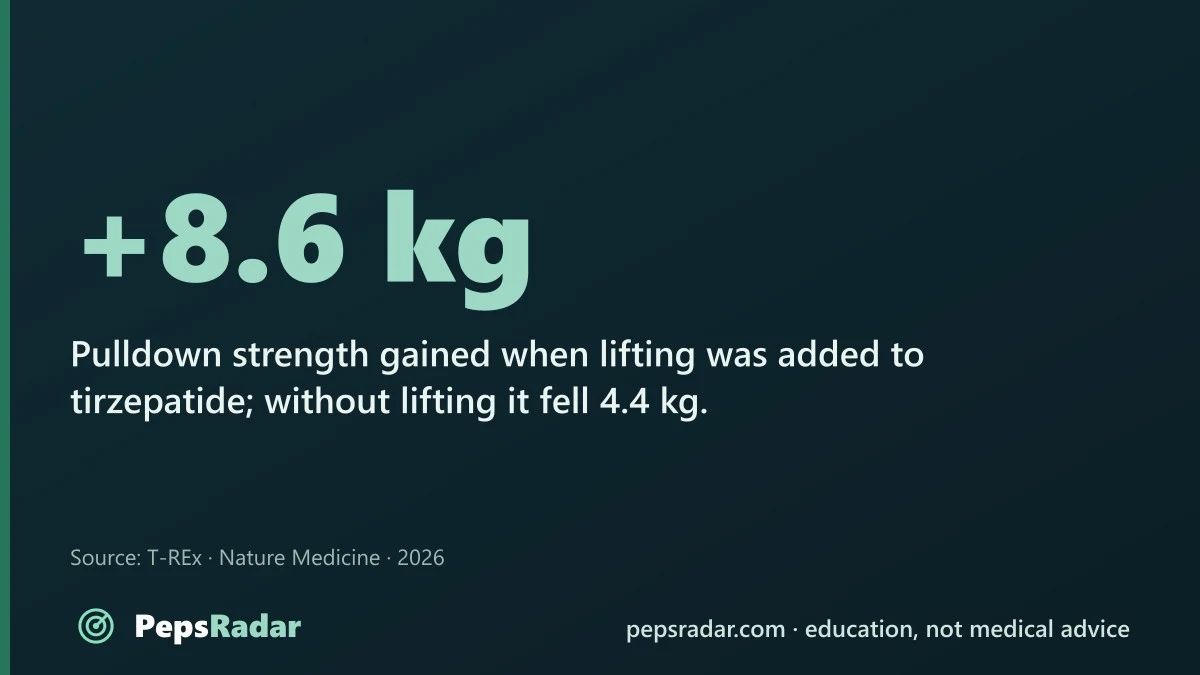
Strength told the clearest story. Without training, bench press fell 4.1 kg, lat pulldown 4.4 kg and knee extension 4.4 kg. With training they rose 4.7 kg, 8.6 kg and 5.9 kg. Several authors report speaker fees from the drug's maker.
Older adults and protein: less settled
In a small post hoc look at SURMOUNT-1, people aged 65 and older on tirzepatide lost 76% of their weight as fat, close to the younger groups, but the authors warn that these subgroups were small. Older people were thin on the ground in the wider evidence too: average ages in the 2026 review's trials topped out at 63.7, and the 2024 review flags older age as a reason to weigh sarcopenia risk.
Protein is often suggested alongside these drugs, but it has not yet been shown to help in a finished trial. The LEAN-PREP trial, now under way, is testing resistance exercise, extra protein and both together in people starting semaglutide or tirzepatide.
Source: Look et al. · SURMOUNT-1 DXA substudy · 2025 ↗
Source: Batsis et al. · Ann Intern Med · 2026 ↗
What is still unknown
None of the 35 trials in the 2026 review reported objective physical function tests, and none of the studies here tracked falls or fractures. Whether the lean mass lost on these drugs changes strength, mobility or injury risk over years is still an open question.
Keep the trade-off in view. In STEP 1, semaglutide also improved cardiometabolic risk factors and self-reported physical functioning compared with placebo. PepsRadar gives no dosing or treatment advice; if you take one of these medicines, talk with your prescriber about an exercise plan.
Source: Batsis et al. · Ann Intern Med · 2026 ↗
Source: Once-Weekly Semaglutide in Adults with Overweight or Obesity. ↗
Continue with the original research
Study examples are based on selected publication abstracts and the explicitly described source documents. This is not a systematic review or an individualized treatment guide. Editorial scope and methods.