 Peps

Two drugs in one weekly shot
CagriSema is Novo Nordisk's name for a fixed combination of two injectable peptides given once a week: cagrilintide, a long-acting amylin analogue, and semaglutide, a GLP-1 analogue. The idea is to test whether the pair does more than either alone.
The first human study of the pair, published in 2021, gave the combination to 96 otherwise healthy adults with overweight or obesity for 20 weeks. The authors judged the combination well tolerated and said larger, longer trials were needed.
Source: Enebo et al., Lancet 2021 (phase 1b) ↗
Source: Novo Nordisk, REDEFINE 1 headline results (Dec 2024) ↗
REDEFINE 1: about a fifth of body weight
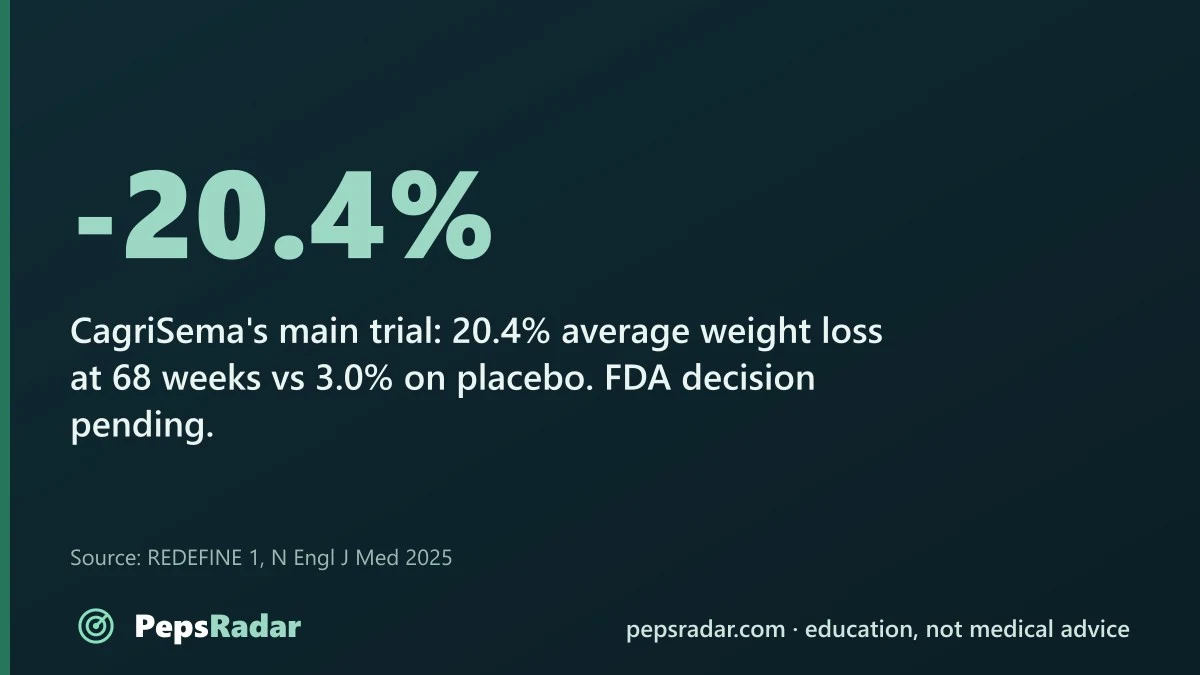
The main phase 3 trial, REDEFINE 1, enrolled 3,417 adults without diabetes who had obesity, or overweight plus a related health problem, for 68 weeks alongside lifestyle support. Counting everyone, whether or not they stayed on treatment, average weight change was -20.4% on CagriSema versus -3.0% on placebo.
The trial also had semaglutide-only and cagrilintide-only arms. On the same count-everyone basis, Novo reported 14.9% weight loss with semaglutide alone and 11.5% with cagrilintide alone, so the combination added roughly five and a half percentage points over semaglutide by itself.
Stomach and gut side effects such as nausea, vomiting, diarrhea and constipation affected 79.6% of people on CagriSema versus 39.9% on placebo. The trial reported them as mostly mild to moderate and temporary.
Source: Coadministered Cagrilintide and Semaglutide in Adults with Overweight or Obesity. ↗
Source: Novo Nordisk, REDEFINE 1 headline results (Dec 2024) ↗
Diabetes, and a direct test against semaglutide
REDEFINE 2 tested CagriSema in 1,206 adults with type 2 diabetes and overweight or obesity. Weight change at 68 weeks was -13.7% versus -3.4% on placebo, and 73.5% of the CagriSema group reached an HbA1c of 6.5% or lower, compared with 15.9% on placebo. Gut side effects were again more common (72.5% versus 34.4%).
REDEFINE 5, run in 331 adults in Japan and Taiwan, compared CagriSema directly with semaglutide alone. Assuming people took treatment as intended, weight change was -18.4% versus -11.9%. Gut side effects were similar between the groups (53% versus 51%).
Source: Cagrilintide-Semaglutide in Adults with Overweight or Obesity and Type 2 Diabetes. ↗
Short of the target, and behind tirzepatide
When Novo released the REDEFINE 1 headline numbers in December 2024, the result fell short of the 25% weight loss the company had previously set as its goal, and its shares dropped sharply. Novo pointed out that the trial let people adjust their dosing and that only 57.3% of the CagriSema group were on the highest dose at 68 weeks.
In February 2026, Novo announced REDEFINE 4, an open-label 84-week trial in 809 people comparing CagriSema with tirzepatide. Among people who stayed on treatment, weight loss was 23.0% with CagriSema versus 25.5% with tirzepatide; counting everyone, it was 20.2% versus 23.6%. The trial did not meet its main goal of showing CagriSema was non-inferior on weight loss. Novo said further trials are testing higher doses.
Source: Clinical Trials Arena (Dec 2024) ↗
Source: Novo Nordisk, REDEFINE 1 headline results (Dec 2024) ↗
Filed with the FDA, not yet approved
Novo announced on December 18, 2025, that it had submitted a New Drug Application to the FDA for CagriSema for weight management, based on REDEFINE 1 and REDEFINE 2. That release stated CagriSema is not approved in the US or EU.
A Novo release on September 30, 2026, said a decision is expected in the fourth quarter of 2026. In its November 4, 2026, quarterly report, Novo said it was preparing for a US launch in early 2027, subject to regulatory approval. No approval had been announced as of that report.
Source: Novo Nordisk, FDA submission (Dec 2025) ↗
Research vials are not CagriSema
The FDA states that cagrilintide is not a component of any FDA-approved drug, has not been found safe and effective for any condition, and cannot be used in compounding under federal law. The agency also warns about products falsely labeled "for research purposes" or "not for human consumption" that are sold to consumers with dosing instructions, and urges people not to buy them because their quality is unknown. Results from Novo's trials say nothing about what is inside those vials.
PepsRadar reports research and regulatory news only. We do not give dosing or treatment advice; decisions about weight-loss medicines belong with a licensed clinician.
Continue with the original research
Study examples are based on selected publication abstracts and the explicitly described source documents. This is not a systematic review or an individualized treatment guide. Editorial scope and methods.